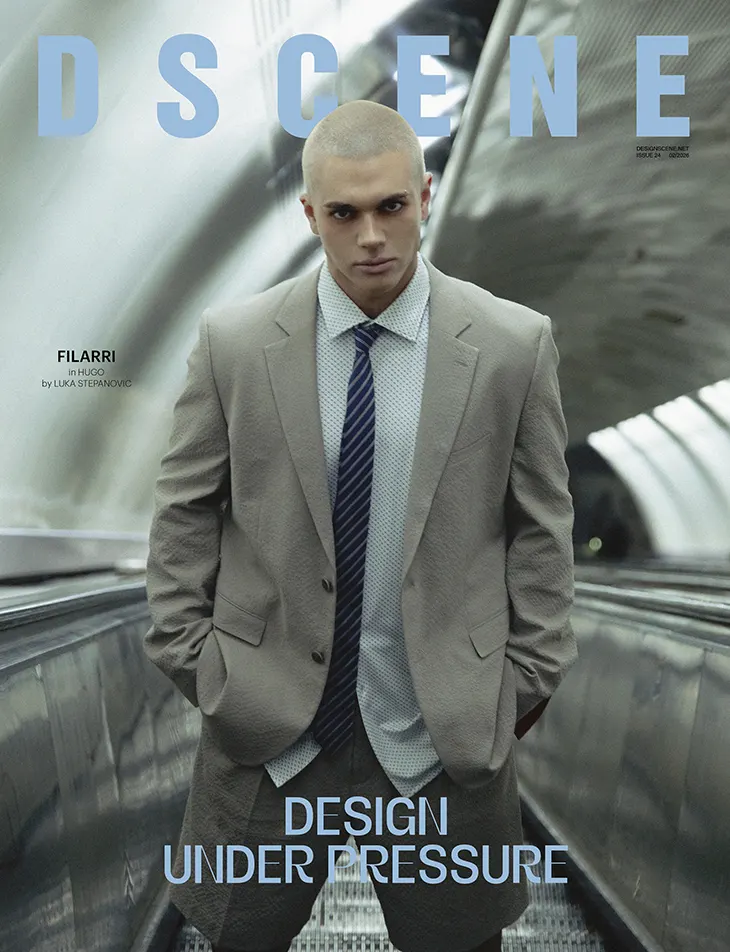
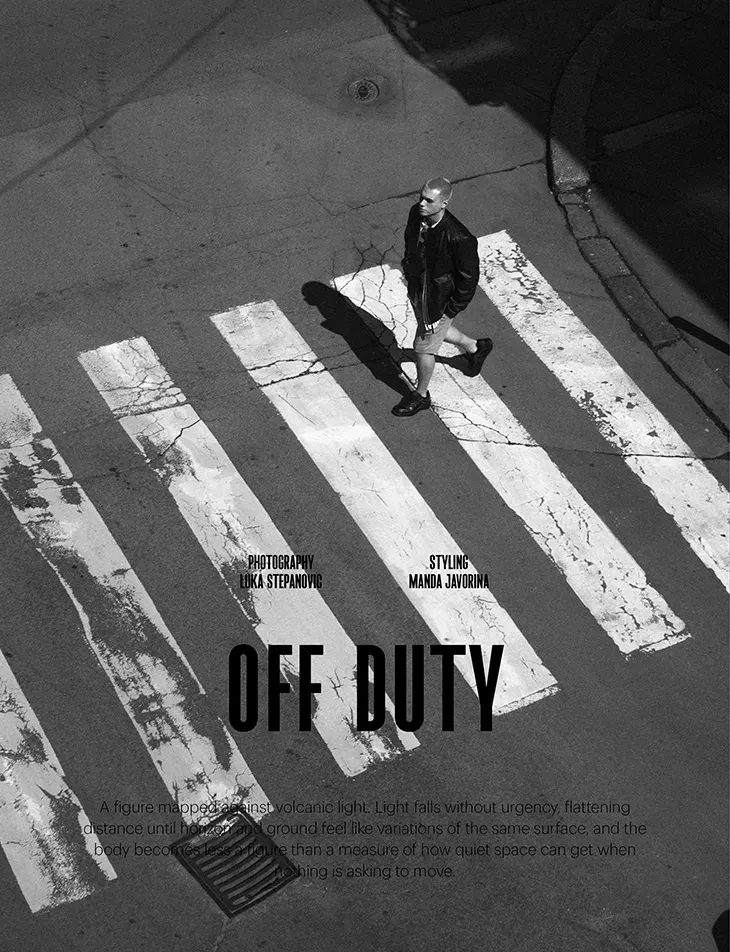
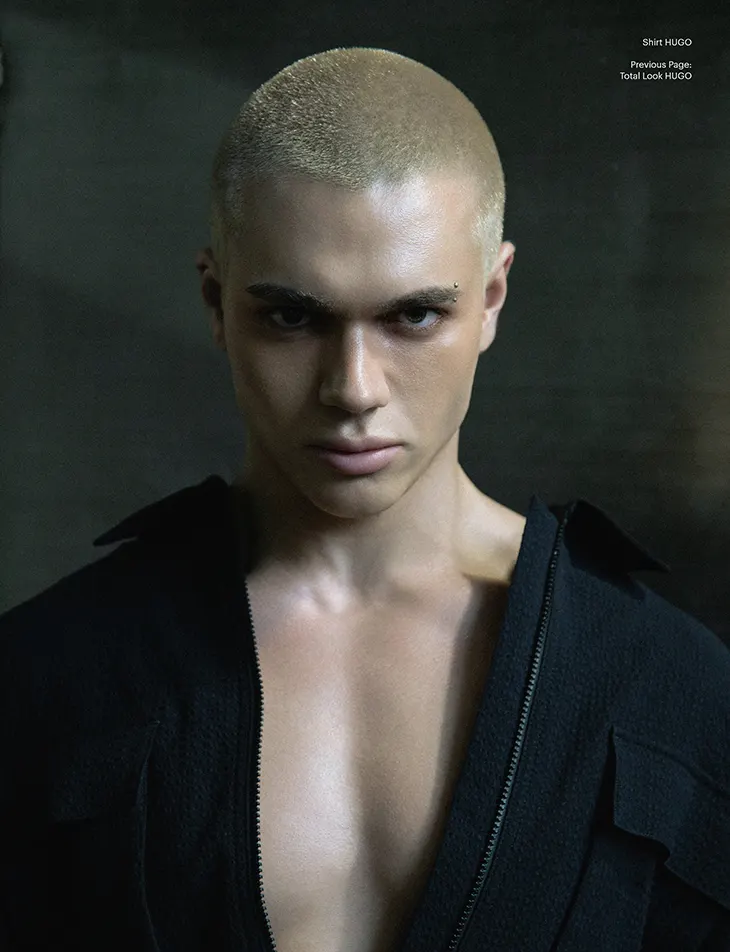
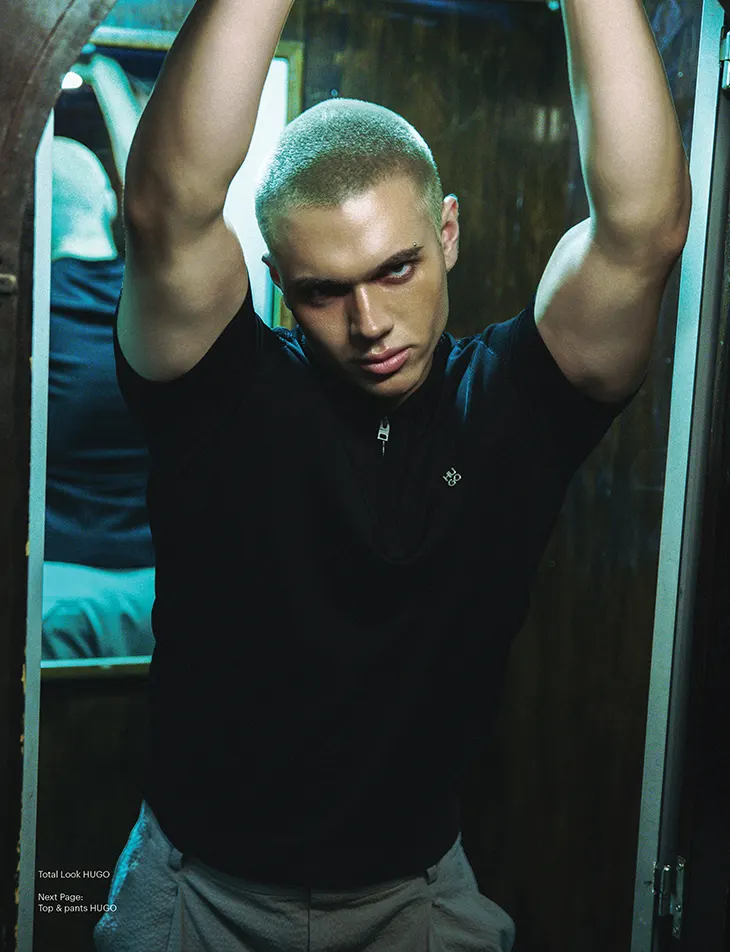
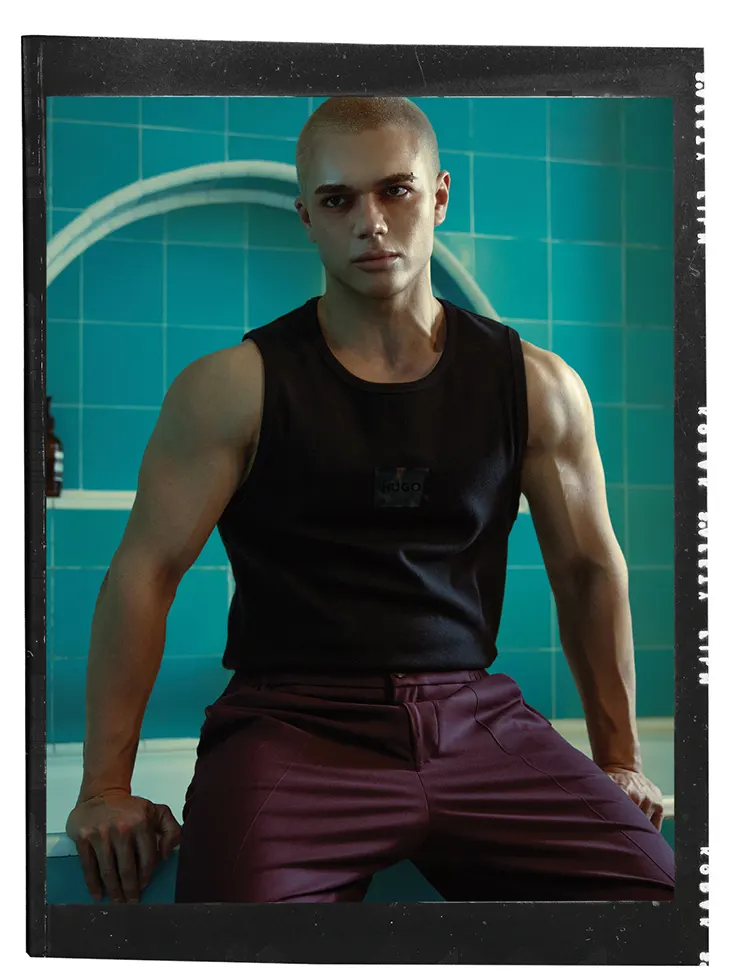
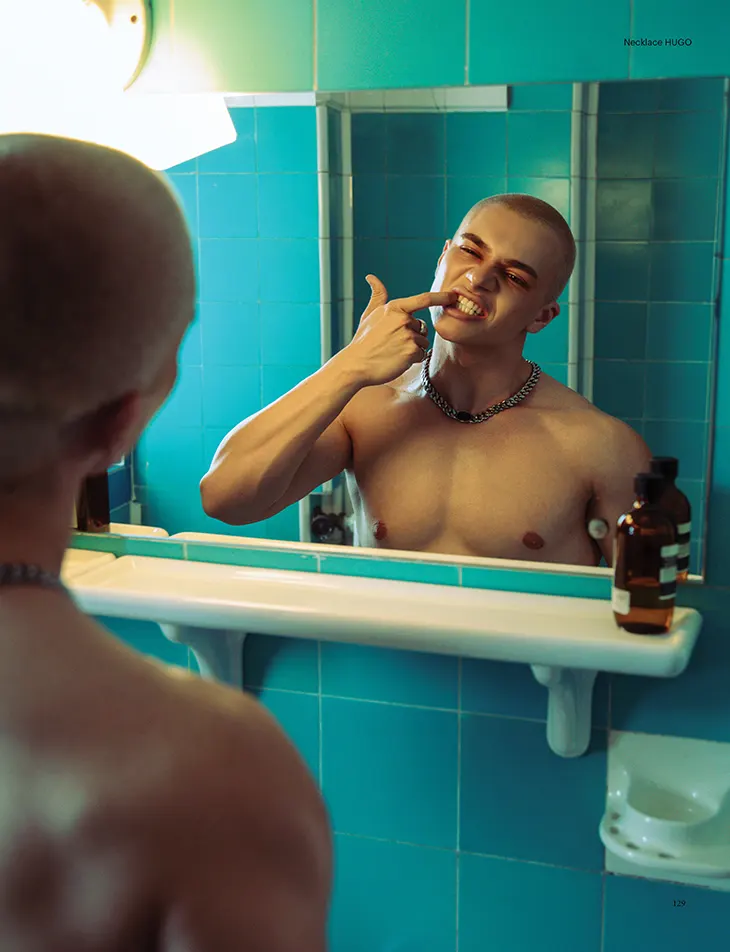
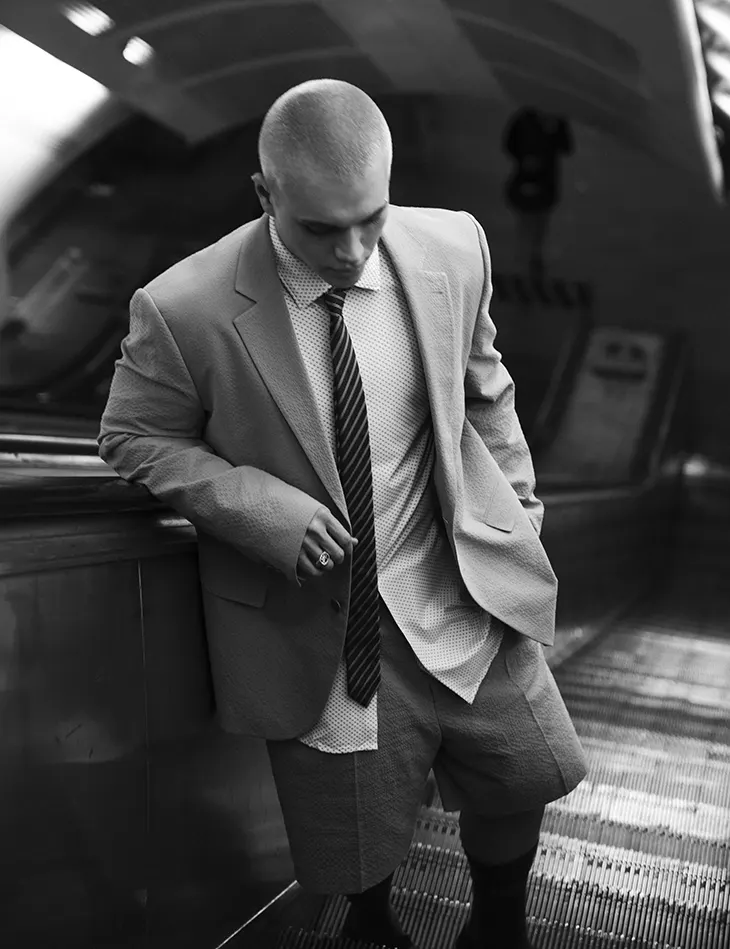
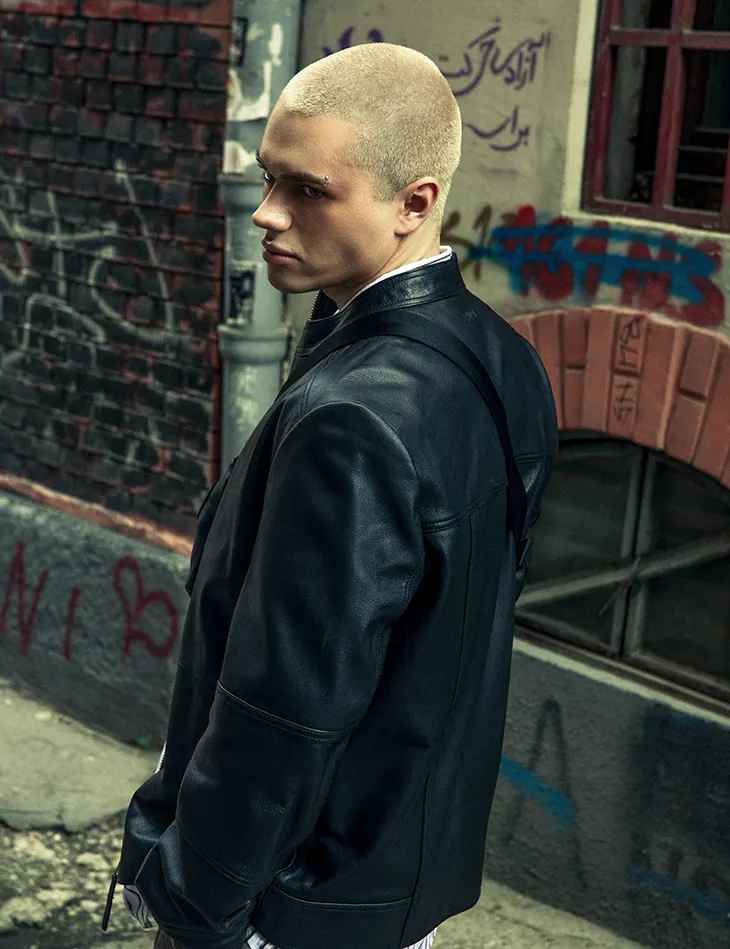
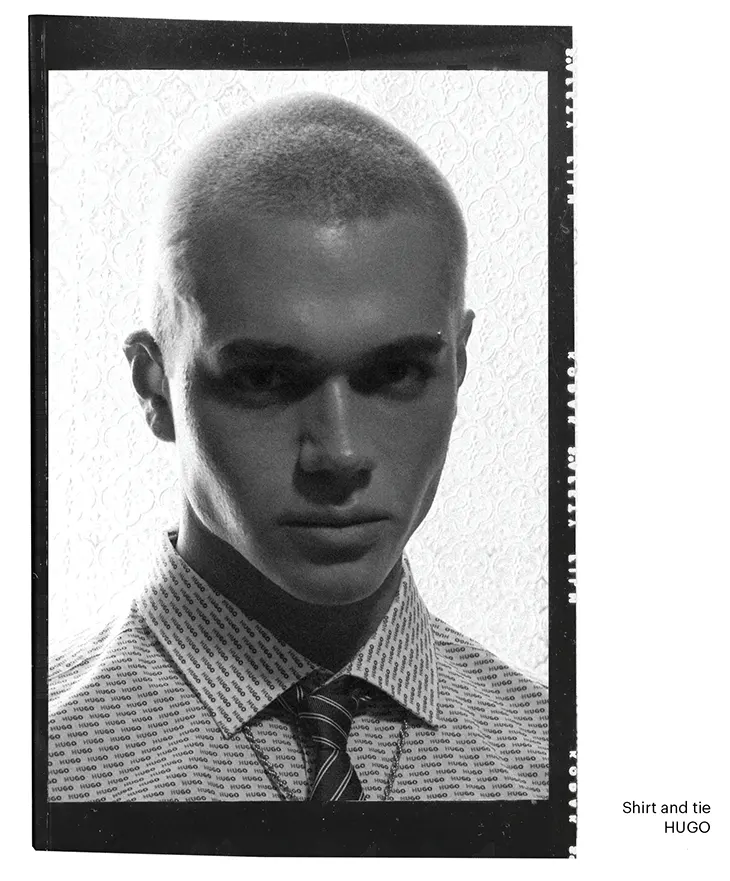
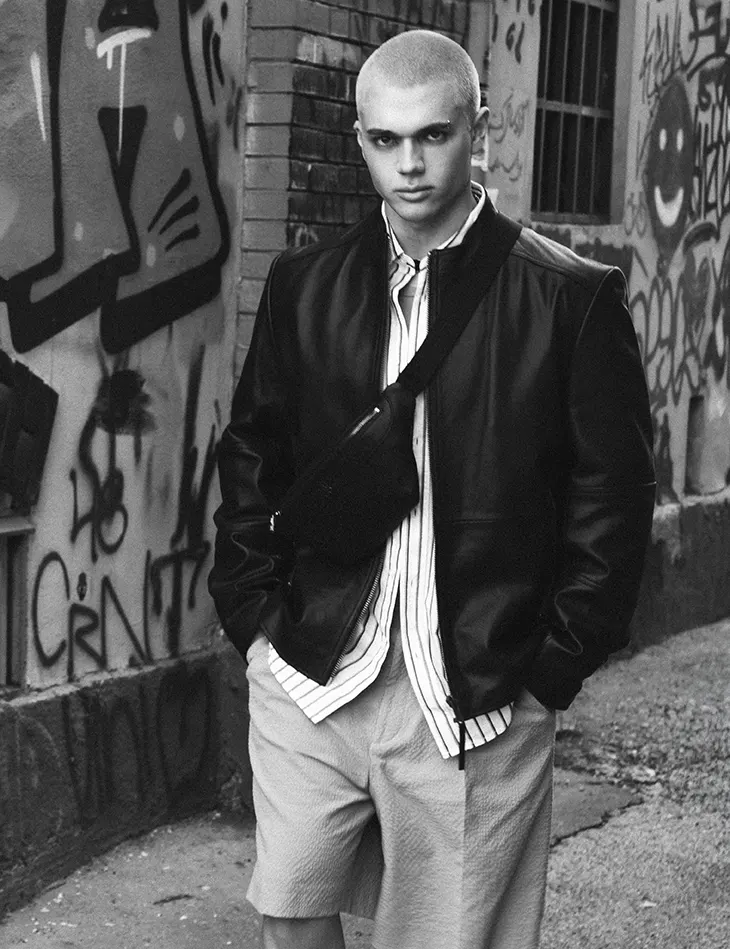
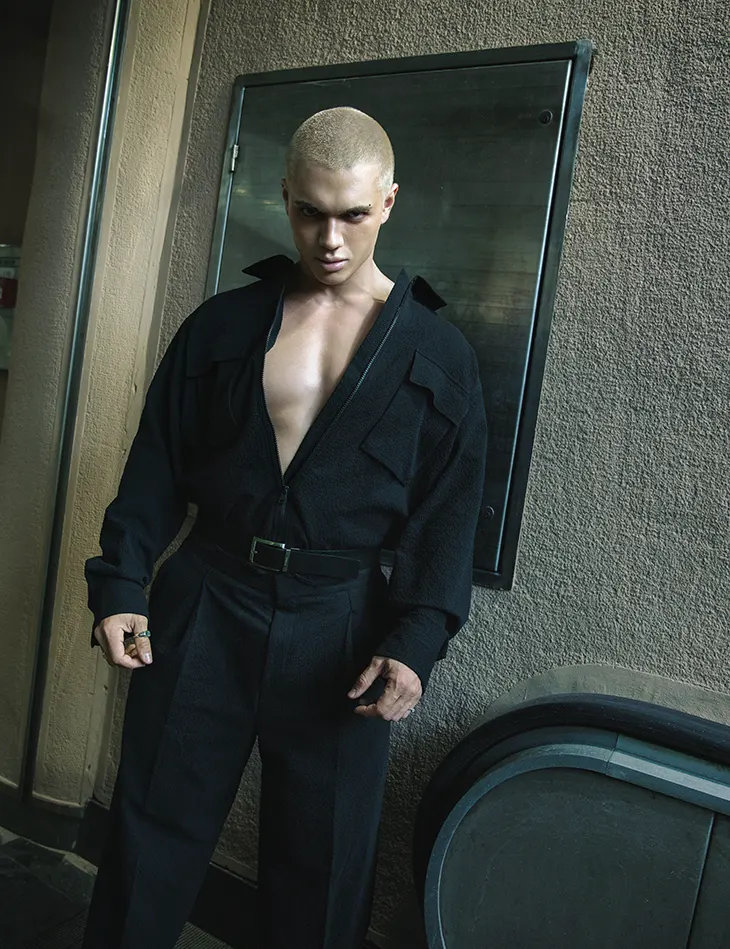
For DSCENE Magazine’s Design Under Pressure issue, FILARRI is photographed by Luka Stepanovic in a fashion story styled by Manda Javorina, wearing a total look from HUGO. The shoot brings together grooming and makeup by Arthur Khatt, assistance from Uros Pajovic, and production by Borislav Utjesinovic, framing FILARRI through a clear, focused visual language that complements the accompanying interview.
ORDER IN PRINT AND DIGITAL
In conversation with DSCENE Editor in Chief Zarko Davinic, FILARRI discusses the emotional intensity behind his debut album Od krvi i mesa, his collaboration with Ljubba, and the pressure that comes with public visibility. He also reflects on social media, masculinity, vulnerability and the need to protect a more private creative space while continuing to develop his work on his own terms.
Od krvi i mesa is framed as your most “unfiltered” work so far. What did you have to stop doing, creatively or emotionally, to allow that level of honesty to come through?
“Od krvi i mesa”, my first studio album, is truly a special project for me. I wanted to be honest to the core, to fully strip myself down emotionally, and to allow the audience to truly get to know me by listening to the album from beginning to end. The album is very conceptual and carries deep, personal, and realistic stories. That is why I would love for listeners to experience it as a whole, because I believe that gives it an additional artistic value, weight, and expression. I did not have to let go of anything quite the opposite. I had to embrace all of my creativity, all of my emotion, and be brave enough to fully live through it. Together with my collaborators, I wanted to turn all of that into a musical and audio-visual work that could present the world of this album to the audience as powerfully and honestly as possible.
You’ve said “Riski” is the door into the album’s world, a space where impulse and reason collide. When you look at your own life right now, where do you feel that collision most intensely?
“Riski” is the lead single of “Od krvi i mesa”, and we chose it because it carries a cross-section of the entire album through its vibe, emotion, genre, and energy. There is a little bit of everything in that song, which is why I called it a kind of new genre: hyper folk. The emotions that exist on the album were emotions I was living through at the time we were creating it. The audio part of the album was finished about a year and a half ago, and certain moments, stories, collisions, waves, and oscillations from that period of my life remained captured in it. Today, I am in a much more beautiful, peaceful, and stable phase. I do not feel that same collision in the same way anymore. More than anything, I am happy that everything we created back then is finally going to see the light of day. I think listeners will be able to recognize for themselves which songs carry those collisions the most.
The album is built as eight stories, with different versions of you, including parts you have not shown before. Which “version” of yourself was the hardest to put on record, and why?
The album has eight full songs and one additional track that works as an interlude, or an introduction to one of the songs. When I think about this question, I immediately think of two songs that are the most emotional for me “Paranormal” and “Filarri”. They are the last two songs on the album, and honestly, I cannot decide which one was harder to bring out, live through, and release emotionally. Every time I listen to the album and I always listen to it from beginning to end I completely break down at the end, and I never know whether it is because of “Paranormal” or “Filarri”. That is the version of me that says most directly: I am human, made of blood and flesh. It may sound simple to some people, but it was important for me to show that things affect me too, that I go through the same human processes as everyone else, even when it might look different from the outside.
Our issue theme is Design Under Pressure. What does “pressure” look like in your daily life, not only as a performer, but as a person expected to share, explain, and stay visible on social media?
It is an interesting question, because I have not thought about it deeply in a long time. If you had asked me about pressure at the beginning of my career, I would have said that I love it and that I function best under pressure. I still believe that when I have a clear goal, a deadline, or something I am preparing for, I can deliver my best results. However, over time I realized there is another side to it. Even though people might expect me to have become more resistant to pressure, the opposite happened I increasingly feel the need for my own comfort zone, especially when I am working on something artistically important, honest, and emotionally demanding. In those moments, I need a safe circle around me, whether that is a physical space or people I trust, people with whom I do not feel threatened in any way. It is similar with social media. Before, I loved filming, taking photos, and sharing parts of myself every day. Today, I have become much more protective of my privacy and of the part of myself that I used to give to the audience so easily. I have gone through many intense things in my career in a short period of time, even though I am still young, and I think it is natural that now I feel the need to keep certain parts of myself for myself.
You’ve spoken openly about not fully loving the influencer, model, content-creator side of the job, and about the weight of the “digital moment.” Do you ever feel pressured to perform a persona online that does not match who you are offline?
My absolute comfort zone is music the piano, singing, composing. That is the space where I feel the most natural and the most honest. No matter what is happening in my life, music is something I can always return to. Social media is different. There, you often have to be smiling, in a good mood, interesting, and engaging enough to keep people’s attention. And that is not always aligned with how you truly feel. I would not say that comments affect me more than before, but what scares me more and more is the fact that you can never fully please people. As I grow older, I become more aware of consequences and of the ways something can be interpreted. Not because I have bad intentions or problematic views, but because people can sometimes interpret even something that was not said with bad intent in that way. And you do not have complete control over that.
With a debut album, there is always the pressure of “proving” something. What kind of pressure did you feel while delivering Od krvi i mesa, and did that pressure ever change the music, the lyrics, or the final tracklist decisions?
What is most beautiful about this album is that there was very little stress around what anyone would say once we released it. We worked only according to what we felt and how we saw that entire world without compromise. Ljuba, who is the composer and lyricist of the songs, and who also directed the music videos, is truly a genius person to me. The two of us connected on a much deeper level, and I think that through this project we grew together, but also healed certain parts of our lives. We did not allow pressure, calculation, or expectations to influence the choice of songs, the tracklist, the themes, or the concept. There was no censorship. Everything you hear and see on this album was there from the very beginning.
The title suggests vulnerability and mortality, the idea of being human, imperfect, and “touchable.” How do you protect that humanity when the public often expects artists to be untouchable, flawless, or constantly “on”?
I try to always look at the positive side of everything and remind myself why I wanted to do music in the first place. That prevents my genuine love for creating from being poisoned by the way other people perceive me, or by whether they agree with the way I live and create. I try to isolate myself from social media comments as much as possible, even though that is difficult because a big part of my work exists there and I have to stay informed about what is happening. Still, I somehow manage to create distance, because I do not want anything to ruin my love for music and creation.
In societies where openness, sensitivity, and nonconformity can still be met with judgment, what kinds of social pressure have you felt most strongly, and how did you translate that into the album rather than censoring it?
Unfortunately, the internet has given many people a space to judge and spread negative energy without much responsibility, especially toward people who are truly themselves, who are not afraid to live the way they want and to be happy. The pressure I have felt most strongly is connected to stereotypes about how a man “should” or “must” look and behave. My fluidity and artistic expression are often judged, and at times people even try to forbid them. I also find myself targeted by very influential people, which is another thing I have to fight against. My team and I translated all of that into the songs and music videos, through a clear message that it is okay to be yourself and that you should accept yourself at every moment.
Your collaboration with Ljubba seems built on deep trust and a shared language, almost like “two sides of the same record.” What did you need from him, creatively and personally, to feel safe enough to go this far?
Ljubba and I are truly deeply connected and we understand each other very well. We think in a very similar way, maybe even the same in some things. I believe we were brought together by fate. We did not analyze what either of us needed from the other; everything happened spontaneously. It felt as if I had something he needed in order to express what he carries inside, and as if he had something I needed in order to express what I carry inside. Essentially, it is the same theme seen from two different angles. That is why I truly feel that the two of us are two sides of the same record.
When you say the album contains both darkness and light, it implies a deliberate design, an emotional architecture. If you could describe the album as a space you built for the listener, what are they meant to confront inside it, and what are they meant to leave with?
If I had to describe this album as a space, it would definitely be an amusement park. From beginning to end, the listener goes through a rollercoaster of emotions and comes out full of impressions. I think many people will find themselves in the stories and lyrics, because they are honest, deep, and very human. I would love for the listener to feel accepted at every moment, and if they maybe do not fully accept themselves, I hope this album gives them the strength to do so. The album contains love stories, energetic songs that lift your confidence and feed the ego in a positive way, but also emotional shipwrecks and stories that do not necessarily end happily. At the very end comes the song “Filarri”, which I would love for everyone to be able to rename with their own name. So that by the end of the album, everyone can say: I am a human being made of blood and flesh, and in my chest there is a heart beating just like in everyone else.
Photographer LUKA STEPANOVIC
Photographer Assistant UROS PAJOVIC
Styling MANDA JAVORINA
Grooming and Makeup ARTHUR KHATT
Production BORISLAV UTJESINOVIC
Talent FILARRI
Filarri is wearing total looks from HUGO Spring Summer 2026 collection, available now.