Hatem Ben Hassine as a casting director, sustainable producer, and founder of both HB Creative Agency and SYNCRONI®, has built a career on questioning the status quo and reimagining the backstage experience for fashion’s most complex productions. Drawing from a background that spans aviation, sustainable fashion, and technology, he has developed Syncroni, the first backstage operating system designed to bring order, clarity, and sustainability to runway casting.
Hatem sits down for an interview with MMSCENE / DSCENE EIC Zarko Davinic to discuss motivations and philosophy behind SYNCRONI®, exploring how his personal drive for structure and efficiency led to the creation of a tool that not only reduces material waste and streamlines workflows, but also redefines inclusivity and transparency in casting. His approach is rooted in deep industry experience, a commitment to responsible luxury, and a vision for a more humane backstage environment. Through practical innovation and a focus on community, Hatem and his team are setting a new standard for how creative teams collaborate, adapt, and thrive in an increasingly digital and eco-conscious world.
Continue reading for the conversation between Hatem and Zarko:
What inspired you to create Syncroni, and how does your background in sustainable fashion and technology shape its core mission? – I’ve always been deeply curious and, if I’m honest, a bit obsessive. I constantly question things around me, I love reorganizing, and push myself to rethink how things are done. If you know me personally, you know I’m driven by order and structure. That curiosity always comes to one question: in an increasingly digital and eco-conscious landscape; why do we still operate the way we do?
In an industry that worships the new, our workflows remain surprisingly outdated. Each show still relies on hundreds of printed Polaroids, comp cards, endless lists and spreadsheets, and a level of chaos that has become normalised. While I value the tactile and archival side of the creative process, I couldn’t ignore the cost: long hours, material waste, and the silent pressure placed on crews which over time turns into burnout.
Through close collaboration with brands, stylists, and industry experts, we went straight for the pains I lived with: the 3AM wrap-up, endless WhatsApp threads, models waiting four hours in the cold, printed boards and comp cards thrown away after a single use.
Before Syncroni, I worked in aviation with Qatar Airways and later in sustainability, producing and quantifying the environmental impact of working on set. Seeing casting’s footprint clearly showed me a different way of thinking especially as the industry navigates economic uncertainties and adapts to evolving sustainability regulations. Syncroni is grounded in reducing costs, minimising waste, and supporting a future of responsible luxury.
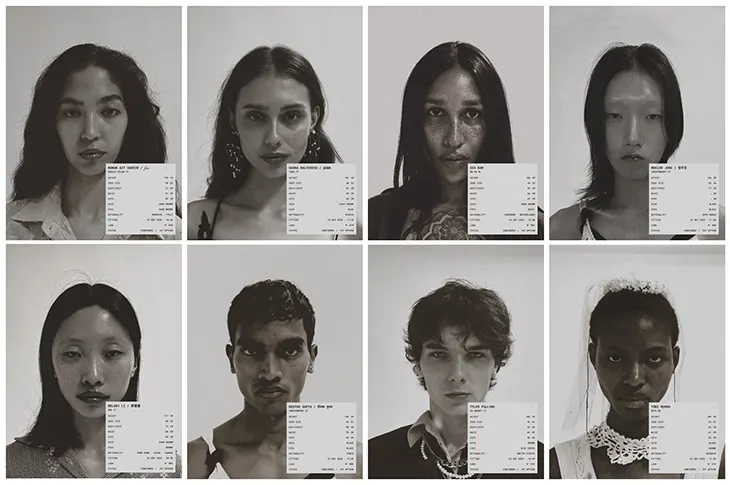
Syncroni is not about disruption or adding another layer of complexity in an already saturated tech and media landscape. It’s about restoring respect for people’s time, balance in the workflow, and clarity under pressure. Our mission is to deliver thoughtful tools that streamline backstage operations and enable teams to work more efficiently within an increasingly digital and environmentally conscious industry. It is built from backstage, for backstage.
How does Syncroni address the specific pain points of traditional casting workflows, and what feedback have you received from teams during Milan Fashion Week SS26? – Through close collaboration with brands, stylists, and industry experts, we went straight for the pains I lived with: the 3AM wrap-up, endless WhatsApp threads, models waiting four hours in the cold, printed boards and comp cards thrown away after a single use.
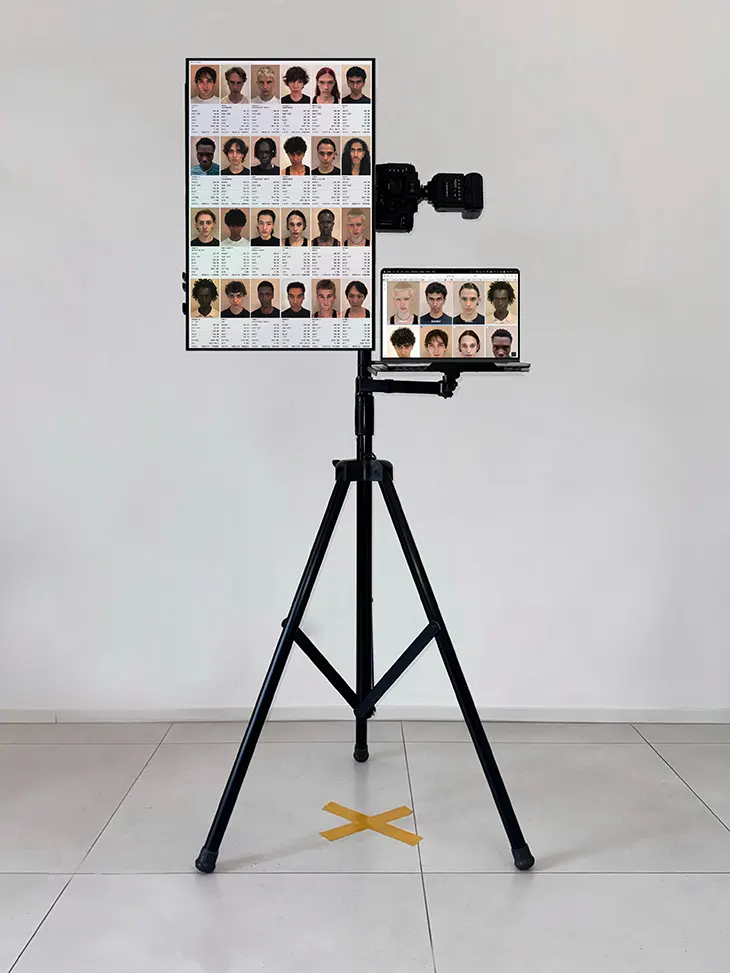
During Milan SS26, we quietly tested Syncroni internally with on shows Marco Rambaldi and Tokyo James. The most telling feedback wasn’t just from designers and crew, but from the models. For the first time, they felt like active participants. The self-check-in kiosk gave them clarity and a sense of control.
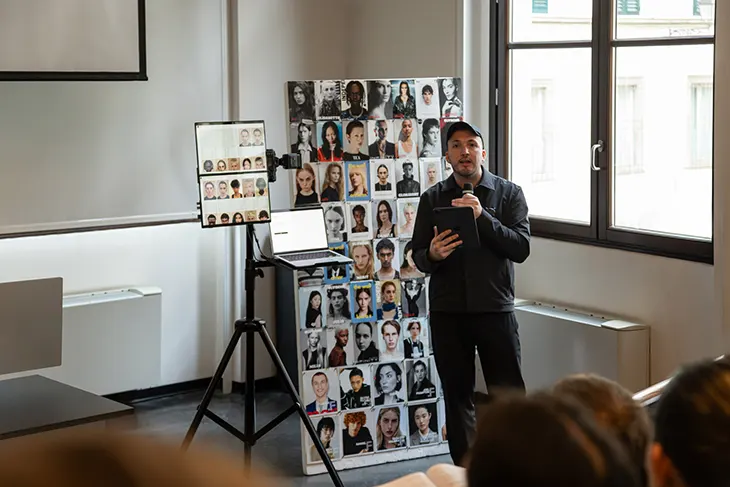
For the teams, the chaos simply dissolved. Casting wrapped at 5 or 7 p.m. instead of dragging past midnight. During casting and fitting days we felt that “the room took a deep breath” and to be honest that’s our fundamental goal: to lift the logistical weight so the creative weight can shine. Sustainability, in this sense, is about reduction and people felt lighter at the end of the day and more in control looking at the entire show from one source of truth.
Can you elaborate on the measurable sustainability outcomes Syncroni has achieved, such as paper reduction and faster decision cycles? – During our internal prototyping test last season, we managed to drastically reduce backstage material waste, eliminating physical comp cards, boards, and hundreds of photo prints, removing the reliance on Selphy printers constantly breaking down mid-day.
We auditioned over 600 model entries with a maximum wait time of 30 minutes and zero failed auditions. This efficiency respects the models’ time and investment, as well as the crew’s energy, while enabling seamless tracking, assignment, and updates of model line-ups, along with real-time communication.
By combining tradition with innovation in a user-friendly interface, Syncroni minimizes backstage chaos and significantly improves show efficiency. Our goal is to build a circular system for backstage operations, maintaining a contained, well-managed workflow that is both socially responsible and environmentally conscious.

How does Syncroni improve collaboration between casting directors, producers, and creative teams in real time, compared to legacy tools like spreadsheets and paper boards? – The problem with legacy tools isn’t that they don’t work; it’s that they all work in isolation. It’s fragile, and it wastes incredible energy. We are not asking teams to change their workflow, but instead we are connecting the fragments they already use and methods that are already familiar.
We didn’t want to replace the ritual of gathering around a board, pointing, debating, feeling the lineup, the casting vibe and the exciting story we wish to tell. The stylist’s board is the casting director’s list is the producer’s live budget. When one updates, they all do. You can still export a spreadsheets, click and print an entire lineup, no editing skills required. Those documents are born from a single shared truth.
It’s about replacing the shouting across rooms and 2AM “which version is this document?” with a space where everyone can work in the way that makes sense for their role, together.
What features within Syncroni help ensure casting processes are more inclusive, transparent, and humane? – Inclusivity is built on access. The platform is deliberately democratic, giving structure to teams who can’t afford casting crew, which naturally opens doors for more diverse talent and narratives and allowing both both agency-represented and independent talent to audition. We also added opt-in diversity filters, not as a performative feature, but as a practical tool for intentionality, allowing teams to consciously shape who they see. We introduced opt-in diversity filters not as a performative feature, but as a practical tool for intentional casting. This matters deeply to our community, which values realness, depth, and cultural plurality.

Transparency is automatic. Every approval, note, or status change is logged in a full audit trail. We wanted to curate an ecosystem that is minimalistic in design but informative and transparent. Syncroni replaces whispers and blurred responsibility with clarity that protects everyone, the model, the agency, the creative team.
Humanity is in the experience. Self-check-in kiosk hands control back to model from the first minute. We eliminated physical comp card, removing financial burden. The system is private by design, but more than that, it’s built to reduce anxiety, not create it. It’s about making the room and more importantly people in it feel respected, seen, and valued.
We’re moving carefully and selectively. Our first focus is gradually connecting model agencies to the platform for real-time updates and data maintenance, which alone removes significant friction.
How does Syncroni integrate with other backstage or production tools, and what role does technology play in bridging creativity and efficiency? – We’re moving carefully and selectively. Our first focus is gradually connecting model agencies to the platform for real-time updates and data maintenance, which alone removes significant friction. We’re building APIs to integrate with calendars, drives, and standard production tools based on real feedback.
We ask a simple question before every integration: does this simplify the day, or add noise? Backstage teams work under pressure and don’t want training manuals. They want tools that disappear into the workflow and earn their place immediately.
Technology’s real role for me isn’t to be “smart.” It’s to quietly manage logistics, create repeatable patterns, and free people to focus on creative output, the ultimate backstage solution for us should feels invisible.
What is the role of the Syncroni Community, and how do you envision it contributing to ongoing backstage innovation and industry education? – We’re building a central resource for backstage knowledge that the industry usually leaves people to figure out alone. For a model new to Milan, it might mean wellbeing guidance or how to take professional Polaroids. For students or emerging brands, it means deconstructing and dissecting the creative process, case studies, and tools to run a professional show.
LATEST INTERVIEWS ON MMSCENE
For independent creatives and freelancers, it’s clear information on rights, regulations, and sustainable practices. It’s about turning principles into shared practice. The community also feeds real insight back into the platform, ensuring Syncroni evolves with the people using it. It’s an open space to learn, share, and build better systems together.

So, what challenges do you foresee in scaling Syncroni to more brands and markets, and how are you addressing them? – The biggest challenge is focus. When you’re curious and see potential everywhere, the risk is trying to do too much at once. Early on, the challenge was translating urgency and vision into something tangible and immediately understandable.
We stopped pitching and started demonstrating. We focused on familiarising people with the system from the ground up, starting with models. During Milan [Fashion Week], their immediate response to feeling respected and in control was our first real proof.
We’re not chasing mass subscriptions or rapid scale. I approach this as an architect; observing the eco-system, understanding its hidden patterns, rules and unspoken pressures before proposing change. Scaling will come through consistent proof, show by show. We’re not selling software; we’re offering a calmer, more humane way to work.
How has recognition from Polimoda Talent 2025 and industry juries influenced Syncroni’s development and credibility? – It gave the project a spine. Before Polimoda, this was a personal frustration. After, it became a shared mission. It provided credibility at a critical early stage.
Backstage teams work under pressure and don’t want training manuals. They want tools that disappear into the workflow and earn their place immediately.
During my master’s at Polimoda, my mentor Lola Young told me, “You care deeply, but you cannot do it alone. Find your people.” Feedback from jurors like Sara Sozzani Maino, who recognised Syncroni as a democratic tool for those without access to traditional casting structures, clarified our direction. That recognition wasn’t a stamp of completion. It was an invitation to keep building with rigour and responsibility.

What are your next priorities for Syncroni’s evolution, and how do you see the platform shaping the future of casting and backstage management? – Our immediate focus is validation and refinement. For Fall/Winter 2026–27, we’re launching structured pilots to stress-test the platform, gather robust data, and refine the core experience with partners beyond our current circle, while exploring potential synergies with teams that share our values and ambitions. We are also strengthening our Trust Pack, data privacy, security, and compliance protocols.
Looking further ahead, I see Syncroni evolving into a trusted partner, phygital standard, balancing tradition and innovation. By combining thoughtful hardware with intuitive software, the platform aims to reduce backstage chaos, increase efficiency, and support teams without being intrusive. Syncroni aligns with the growing emphasis on digital transformation and sustainability. By responding to evolving market regulations and rising expectations around responsible practices, we are building the infrastructure backstage has never had, one show at a time.