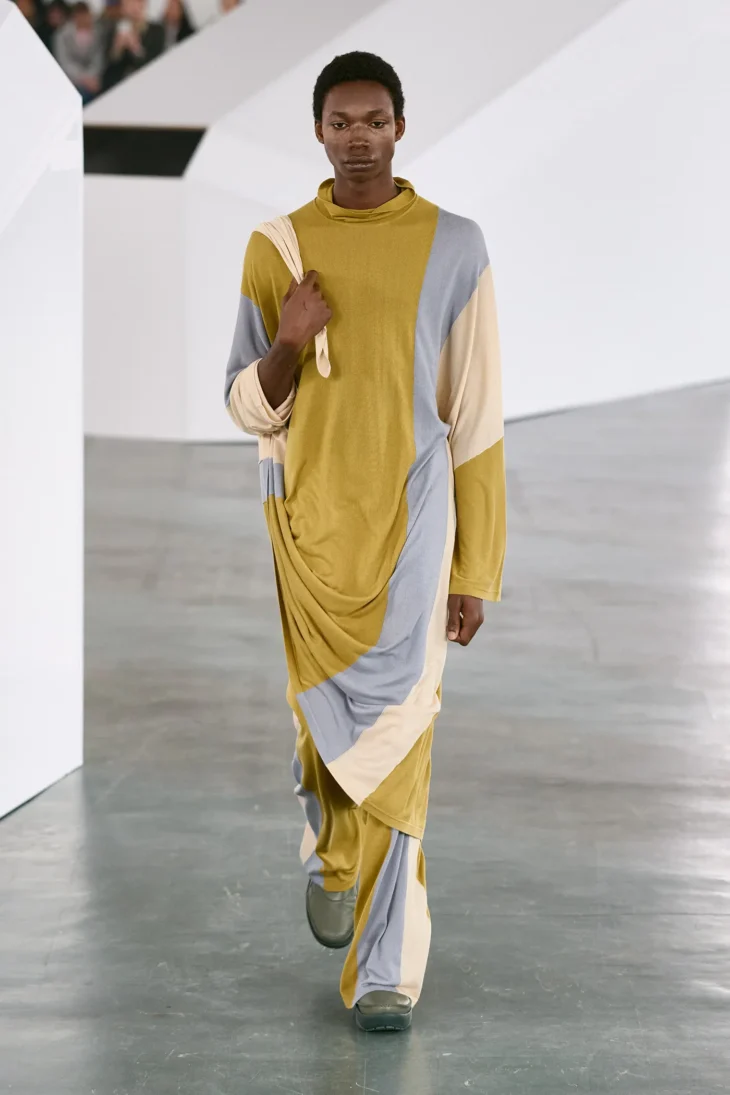
Kiko Kostadinov has always operated at the intersection of rigour and experimentation. For Fall Winter 2026, the Bulgarian-born, London-based designer abandons the character-driven narratives of recent seasons in favour of something more elemental: the garment itself, examined without pretence or projected identity.
Stripping Back to Structure
What does a piece of clothing look like when freed from the weight of storytelling? This question anchors the entire FW26 proposition. Kostadinov and his team have spent this cycle interrogating fundamentals, cut, proportion, the behaviour of fabric, while simultaneously pushing into unfamiliar technical territory.
The result is a collection that unfolds through sequential variation. A silhouette emerges, gets refined, mutates, reappears in altered form. Energy accumulates through repetition. The method feels almost musical: theme and variation, motif and development.
Monastic Mathematics
The collection’s intellectual backbone comes from an unexpected source: Dom Hans van der Laan, a Dutch Benedictine monk who spent decades developing a proportional system he called the “plastic number.” Van der Laan applied his mathematical formulas to everything, abbey buildings, altar furniture, even the habits worn by his fellow monks.
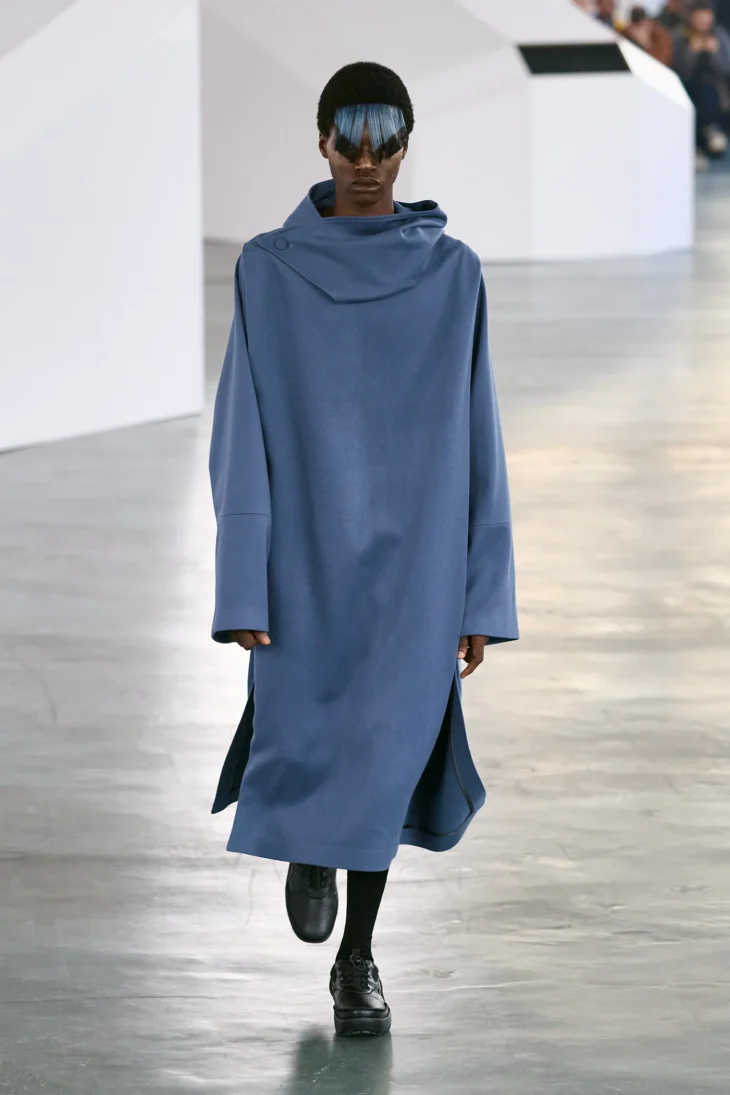
Kostadinov channels this obsessive systematisation. Diagonal cuts recur. Rhombus gussets appear across multiple garments. Proportional relationships echo from piece to piece. The effect is cumulative, you begin to recognise the internal grammar, the rules governing this particular universe of cloth.
Between Categories
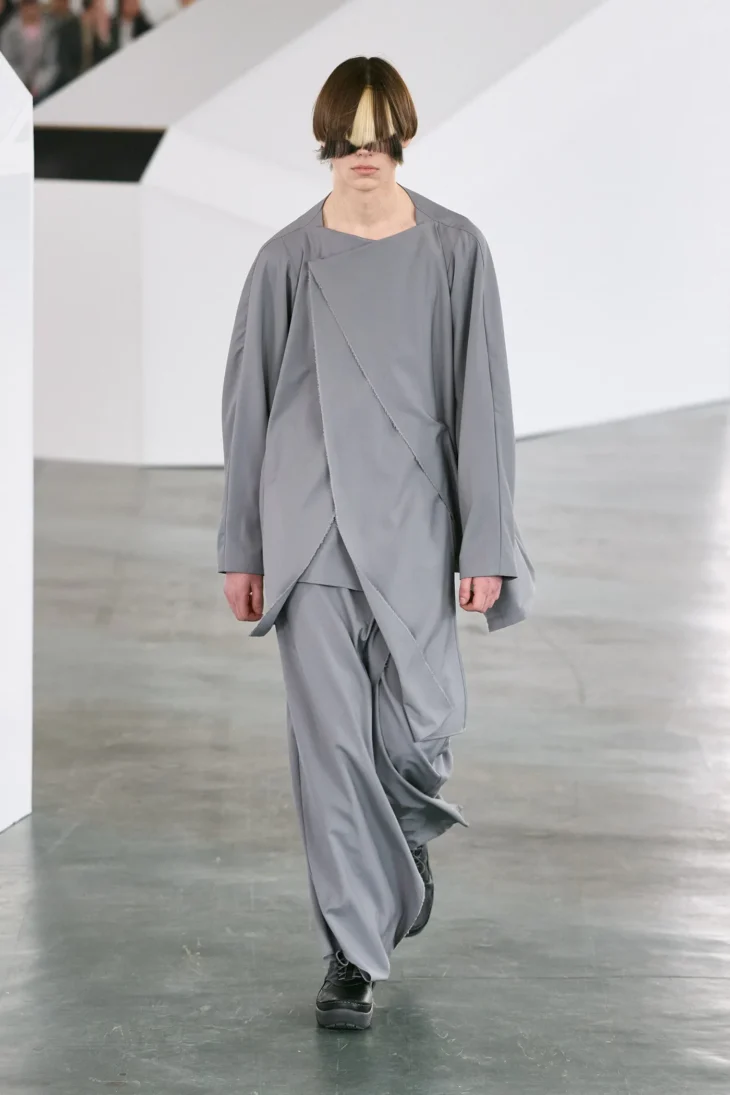
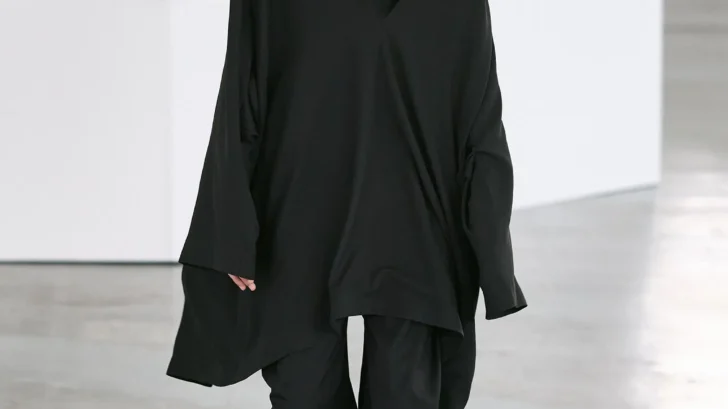
The garments themselves refuse easy classification. A blouson arrives with curved shoulders and a neckline wide enough to suggest something ceremonial. Tops hover in ambiguous territory between pullover, shirt, and jersey. Trousers incorporate enough drape and volume to read almost as skirts.
PARIS FASHION WEEK COLLECTIONS
This categorical slippage feels intentional. Wraps, ties, and adjustable elements mean pieces transform on the body, inviting the wearer to participate in determining final form. The clothes demand engagement rather than passive consumption.
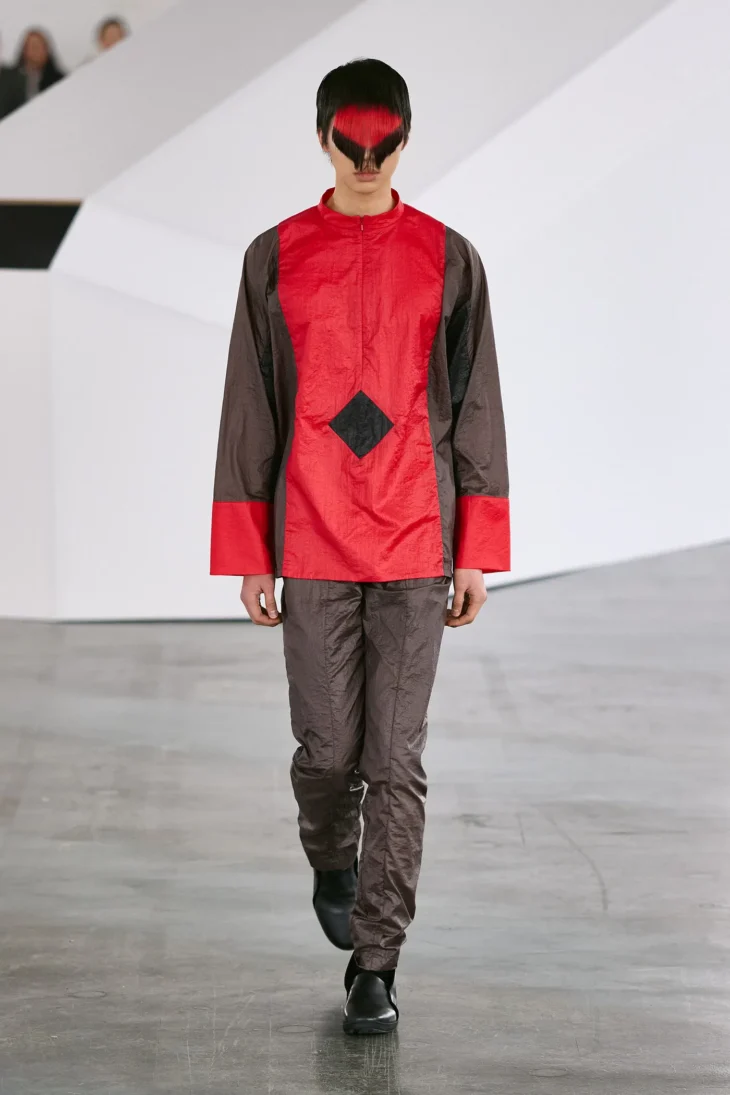
Silhouettes oscillate between geometric precision and organic distortion. Clean lines dissolve into intricate systems of slits, cinches, darts, and folds. Striped knits and layered crinkled nylon punctuate the lineup, introducing pattern and chromatic variation into an otherwise restrained palette.
Luxury Through Simplicity
Material selection prioritises inherent quality over surface treatment. Silk, cashmere, and Loro Piana wool appear throughout, handled with evident generosity. The made-in-Japan suiting programme expands into blazers, trousers, and overcoats rendered entirely in black wool, pieces where the only ornament is the precision of the cut itself.
The colour strategy works through tonal gradations: blacks bleeding into charcoals, creams adjacent to off-whites, blues ranging from navy to slate. Vermillion and sulphur arrive as controlled disruptions, preventing the palette from tipping into austerity.
Invisible Hardware
Kostadinov’s commitment to visual clarity extends to construction details. Topstitching, piping, and trim are minimised. Zippers disappear entirely. Buttons hide behind plackets or match their surrounding fabric, refusing to interrupt the garment’s surface.
Even accessories have been reconsidered. Rather than introduce bags or jewellery that might compete with silhouettes, Kostadinov collaborates with hair artist Tomihiro Kono on a series of coloured wig bands. These geometric interventions obscure models’ faces, directing attention squarely toward the clothing while echoing the collection’s formal vocabulary.
The Casting
Henry Thomas at Bryant Artists assembled a lineup of 19 models whose diverse physicalities became essential to demonstrating the collection’s range. Alexander Acquah, Amir Ogunsi, Benjamin Vansteenberghe, Charles Oluwabusola, Daniel Awaridhe, Douta Sidibe, Enoch Cheung, Gendai Funato, Gwonho Oh, Josh Habib, Kerlual Thak, Lebo Malope, Loup Ruoppolo, Max Vespa, Muscab Abdiwali, Santino Calvani, Stephen Abioye, Venoshan Thirugnanamoorthy, and Vova Tkachenko walked the show.
The casting reflected Kostadinov’s commitment to showing how these architectural garments behave across different bodies. Partially obscured by Kono’s coloured wig bands, the models became moving studies in proportion and silhouette, individuality subsumed into the collection’s formal logic while their varied frames revealed each piece’s adaptability.
Footwear as System
The shoe offering follows the same iterative logic. A new slip-on silhouette appears in two variations: padded leather upper and extended heel with optional black shearling lining. The established Sargo shape continues its evolution through slim-profile leather lace-ups.
The headline collaboration arrives via Crocs, an unlikely partnership that yields surprisingly architectural results. Minimal topstitching, no eyelets, and the brand’s signature heel tab integrated directly into the shoe’s body. Utilitarian directness meets considered design.
Oscar Tuazon’s Cardboard Monuments
The show space features three sculptures by American artist Oscar Tuazon, each constructed from cardboard and paper tape. These minimal architectural forms sit at angles to one another, their linear arrangement mirroring the collection’s own rhythm of repetition and subtle variation.
Tuazon’s practice, rooted in honest materials and fundamental structures, provides ideal context. Both artist and designer share an interest in what remains when you eliminate the unnecessary.
The Takeaway
Kiko Kostadinov FW26 represents a deliberate recalibration. By returning to first principles, the label has produced a collection that feels simultaneously challenging and deeply wearable. These are clothes that reward attention, that reveal their intelligence through sustained looking.
In a landscape cluttered with concept and spectacle, Kostadinov offers something increasingly rare: garments that justify their existence through craft alone.
Discover more of the collection in our gallery:
Credits: Production Experiential/H | Casting Henry Thomas at Bryant Artists | Hair Tomihiro Kono | Make-up Kanako Yoshida at LGA Management | Music Direction Bill Kouligas | Text Eliot Haworth | Communications Ibtissame Bellehouane | Special Thanks Oscar Tuazon and Morán Morán
For the details from the collection visit DSCENE Magazine.