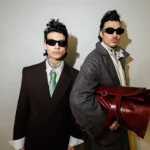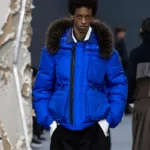
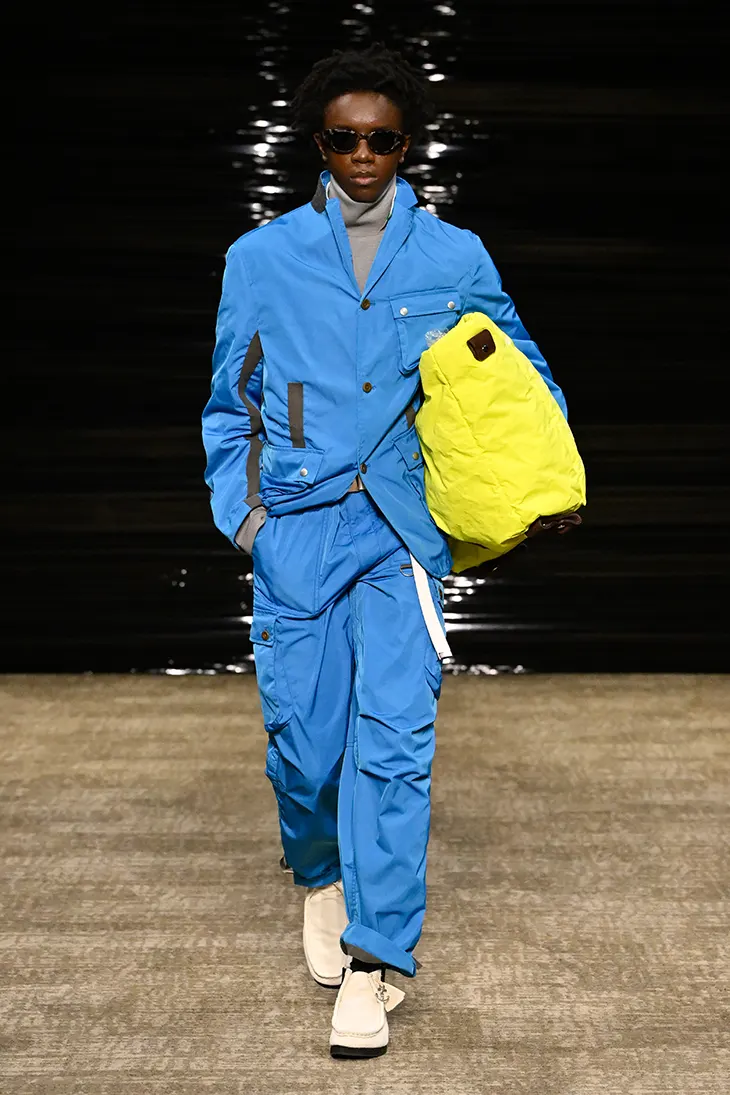
The sea has always been fashion’s most treacherous muse, unpredictable, consuming, indifferent to human ambition. For his second collection as Creative Director of KOLOR, Taro Horiuchi doesn’t merely reference the ocean; he surrenders to it entirely, emerging with a Fall Winter 2026 offering that feels less designed than salvaged from some metaphysical shipwreck. And to bring this vision to life, casting director Isabel Bush assembled a roster of models whose presence transformed conceptual ambition into visceral reality.
FALL WINTER 2026 RUNWAY COLLECITONS
Drawing explicitly from Robert Eggers’ 2019 psychological horror film The Lighthouse and Herman Melville’s Moby-Dick, Horiuchi constructs a wardrobe for those caught between obsession and survival, between the pull of distant light and the certainty of drowning. It’s a bold conceptual framework, one that could easily collapse into costume or pastiche. Instead, Horiuchi navigates these dangerous waters with the precision of someone who understands that true darkness requires restraint.
Beyond Gender: Clothing for Survivors
One of the collection’s most compelling aspects is its refusal to distinguish between menswear and womenswear. The garments exist in a space where such categorizations feel irrelevant, perhaps even absurd. When you’re clinging to wreckage in a storm, the cut of your jacket matters far less than whether it keeps you alive.
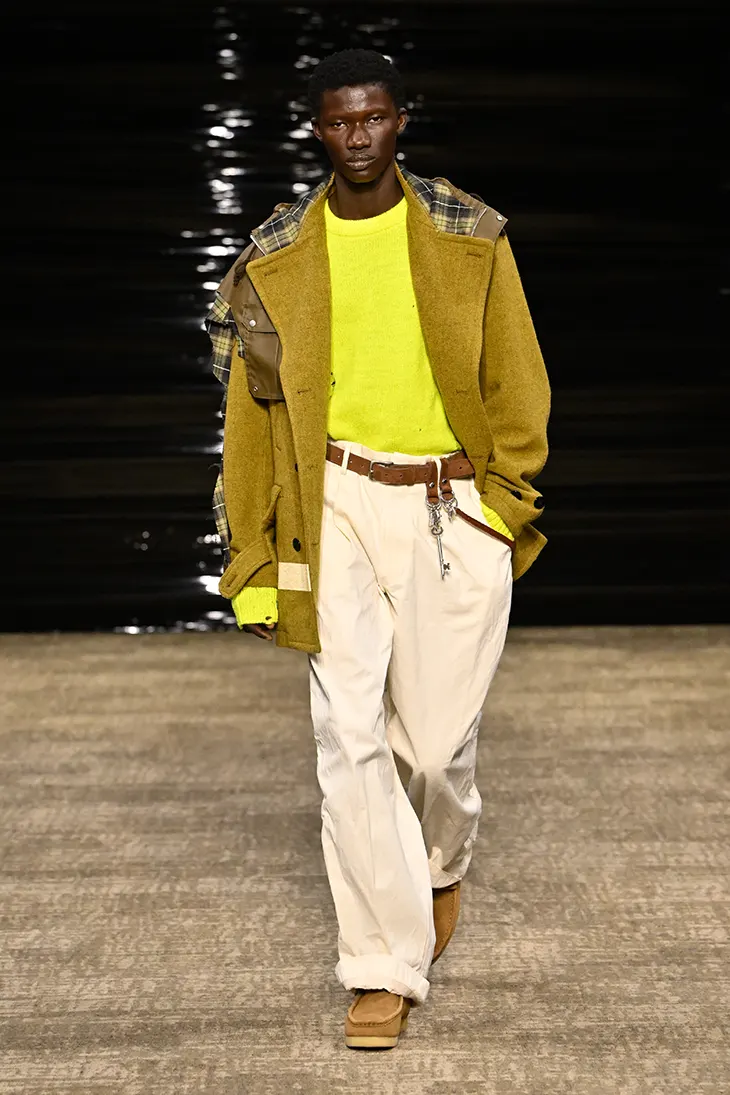
This unisex approach feels organic rather than performative. The silhouettes, the layering, the weathered fabrics, all read as clothing shaped by necessity and circumstance rather than by gendered conventions. High-waisted trousers, oversized shirting, heavy outerwear, these pieces belong to whoever needs them, whoever found them washed ashore. The collection suggests that survival strips away the superficial distinctions we impose in calmer times.
The Casting: Survivors of the Storm
Isabel Bush’s casting proved essential to the collection’s success. The lineup read like a manifest of people pulled from different vessels, different eras, different corners of the world, all united by circumstance and survival.
Among the male models, the casting included Abhishek Prakash, Charles Oluwabusola, Charlie Tilling-Cole, Chol Mabior, Douta Sidibe, Eigil Hjorth, Falilou Ndiaye, Finn Soutter, Gabriel Tiercelin, Joseph Uyttenhove, Ko Eun Woo, Mingyi Tang, Nikita Fen, Padani Kandagama, Rouna Obigba, Saliou Gueye, Shiqi Fang, Taisei Nakacho, Ward Stevens, and Xie Binghuan.
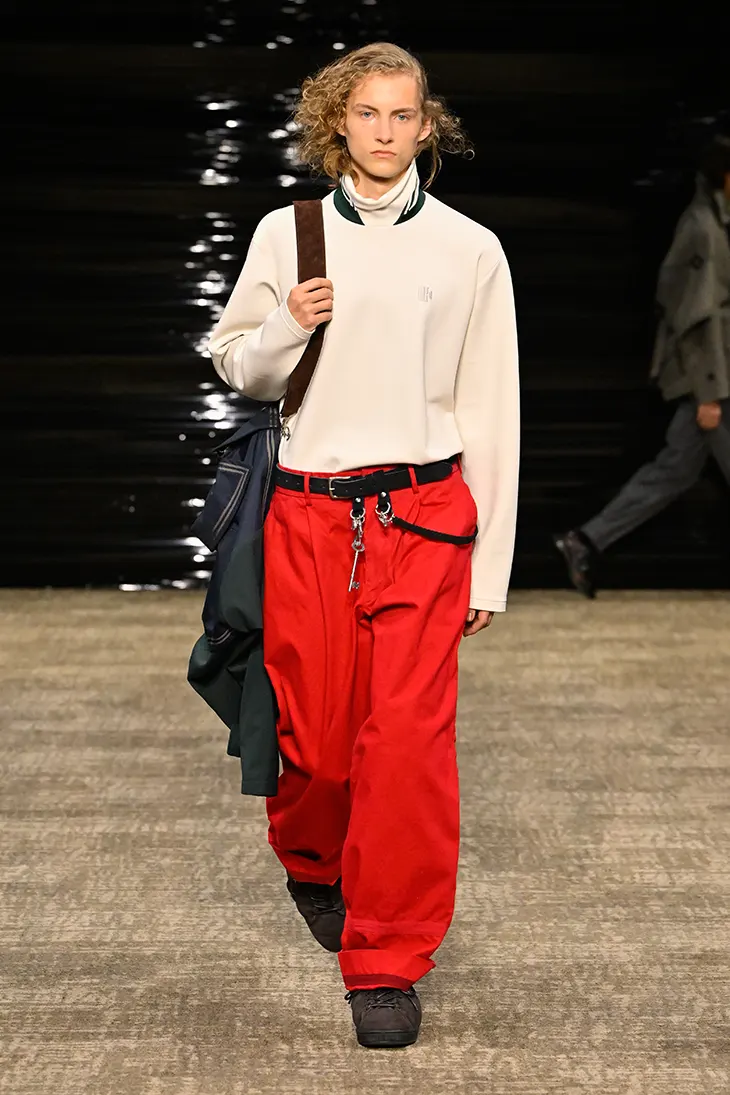
This diverse assembly wasn’t merely tokenistic representation. Each model brought a distinct physicality that served the collection’s narrative of individuals shaped by elemental forces. The range of builds, from lean and angular to broader and more grounded, suggested a crew assembled not by aesthetic uniformity but by shared endurance. These were faces that could belong to lighthouse keepers, merchant sailors, or anyone who had simply seen too much sea.
The unisex nature of the collection meant that similar pieces appeared across the entire cast, reinforcing the idea that these garments transcend traditional categorization. A jacket that appeared on one of the male models could just as easily have walked on a female counterpart, and vice versa. This interchangeability wasn’t a gimmick but a natural extension of the collection’s philosophy: clothing born from survival belongs to no single gender.
The models moved with weighted deliberation, conserving energy as though uncertain when the next storm might hit. Ramona Eschbach’s hair styling contributed appropriately weathered, salt-worn textures, while Stephanie Kunz’s makeup emphasized the thousand-yard stare of those who have spent too long watching the horizon. The overall effect was less fashion presentation than collective portrait of survival.
The Weight of Time Made Tangible
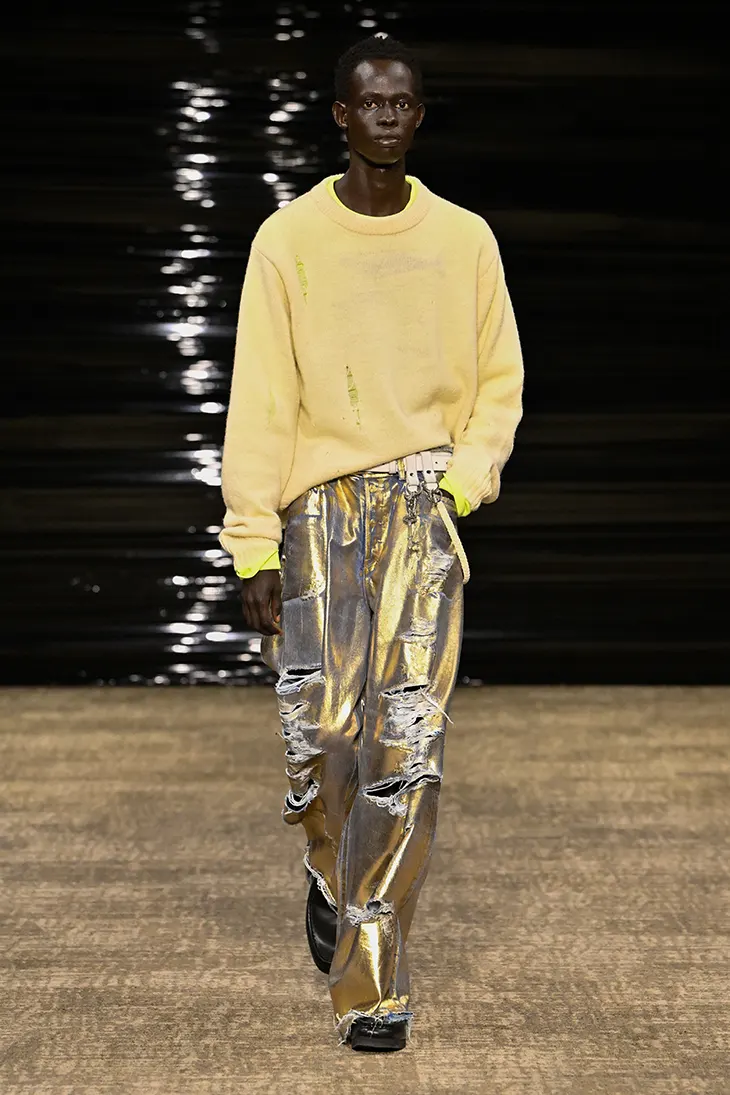
What distinguishes this collection from lesser exercises in maritime nostalgia is Horiuchi’s material intelligence. The fabrics here carry genuine archaeological weight: aged suiting with a dry, almost desiccated hand; shirts so heavily wrinkled they appear to have been worn through storms and dried stiff with salt; canvas that reads as genuinely worn rather than artificially distressed. Buttons sit deliberately misaligned, as though fastened in darkness or desperation. Knits fray at their edges, unraveling in real-time like memory itself.
These aren’t aesthetic choices made for Instagram’s benefit. Horiuchi, whose credentials include the ITS Diesel Award following his graduation from the Royal Academy of Fine Arts Antwerp, plus leadership roles at his eponymous label, th products, MUJI LABO, and DESCENTE ALL TERRAIN, brings a technical sophistication that allows him to age fabric without destroying it, to suggest decay while maintaining structural integrity. The garments look like they’ve survived something, yet they remain entirely wearable.
Cinematic References Without Costume
The collection’s debt to Eggers’ film is evident but never literal. Where a lesser designer might have sent models down the runway in fisherman’s sweaters and oilskin coats, Horiuchi abstracts the film’s visual language into something more insidious. The silhouettes suggest the 1890s setting, high-waisted trousers, layered shirting, heavy outerwear, but filtered through contemporary proportions and fabrications. Modern technical materials appear alongside period-appropriate textures, creating temporal dissonance that mirrors the film’s own fractured chronology.
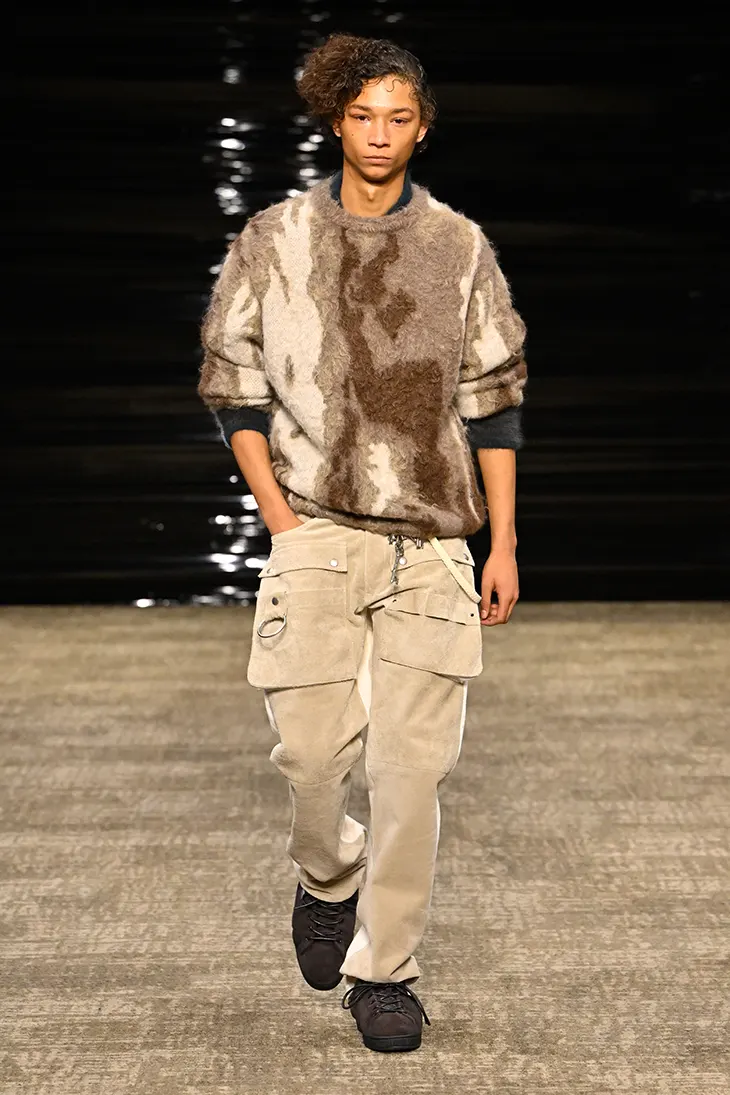
This collision of eras serves the collection’s central thesis: that time moves not linearly but cyclically, that we are perpetually returning to the same fears, the same obsessions, the same desperate reaching toward light. The clothes feel simultaneously ancient and immediate, as though they could have been worn by Melville’s sailors or by someone walking through the Marais this afternoon.
The Rhythm of Collapse and Resurgence
Horiuchi’s show notes speak of “a rhythm of collapse and resurgence,” and this tension animates every piece. Tailored jackets appear on the verge of dissolution yet hold their shape with unexpected authority. Layering feels accidental, garments assembled through necessity rather than intention, yet achieves a coherence that belies its apparent randomness. The overall effect suggests clothing that has been through something catastrophic and emerged transformed but recognizable.
On the bodies of Bush’s carefully selected cast, these garments found their ideal vessels. The diversity of the lineup meant each piece read differently depending on who wore it, the same jacket appearing protective on one model and confining on another, the same layered shirting suggesting warmth or suffocation depending on the wearer’s frame and carriage.
Sound as Structural Element
Kensuke Ushio’s original composition deserves particular mention. The Japanese composer, known for his work on anime series A Silent Voice and Chainsaw Man, created a score that functioned less as soundtrack than as additional design element, waves of sound that ebbed and surged, creating the sensation of being submerged and surfacing repeatedly. The models walked through this sonic landscape as though navigating actual weather, their pacing responsive to the music’s rhythms.
Building on Spring Summer 2026
Having established his vision for KOLOR with his Spring Summer 2026 debut, Horiuchi now deepens the conversation. This second outing demonstrates a designer finding his footing within the house’s existing codes while pushing toward darker, more psychologically complex territory. The progression feels natural, a continuation rather than a departure, suggesting Horiuchi has a longer narrative in mind for the label.
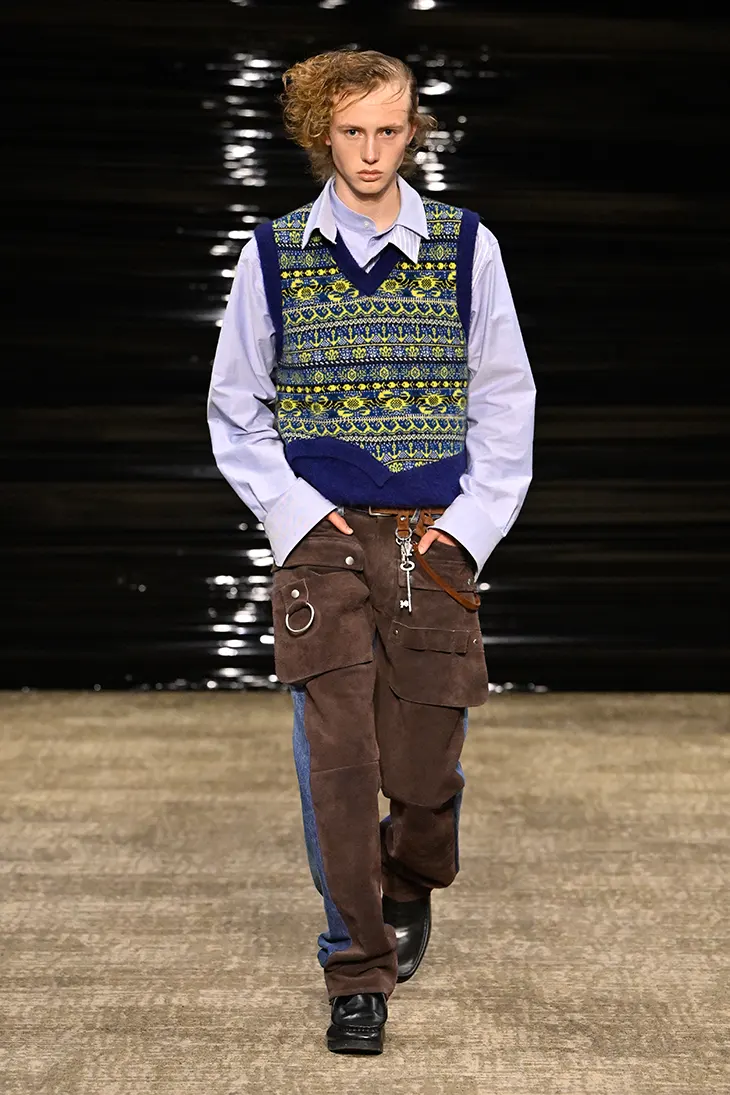
The collection asks what we carry with us through time, what survives the storm, what washes up on distant shores still clinging to our bodies. In the faces and forms of those who walked this show, we glimpsed possible answers: endurance written in posture, survival etched in expression, the quiet dignity of those who have weathered something and emerged, if not unscathed, then at least still standing.
Finally, Taro Horiuchi’s second KOLOR collection confirms his ability to translate complex conceptual frameworks into genuinely compelling clothes, elevated further by Isabel Bush’s exceptional casting and a unisex approach that feels entirely authentic to the collection’s survivalist narrative. The Fall Winter 2026 offering succeeds both as intellectual exercise and as showcase for a new generation of models capable of embodying narrative as much as wearing garments.
Fall Winter 2026 Runway collection for KOLOR see more in our gallery:

Discover the complete collection, including the womenswear assigned looks on DSCENE Magazine.