
A watch tends to get judged first on its dial design or the recognition of its brand name, yet lasting satisfaction usually comes down to factors that are easy to miss in a showroom or an online listing. Movement type, wrist fit, material choices, water resistance, legibility, and long-term upkeep all shape how a watch actually performs once it becomes part of daily life.
Browsing a range of established options, including tissot watches, can help buyers compare specifications and construction methods across different price points, without suggesting that any single maker is inherently better than another.
Start With Your Lifestyle and Intended Use
The right watch depends heavily on where and how it will actually be worn. Someone at a desk job has different needs than a frequent traveler crossing time zones, and both differ from a recreational swimmer or someone working outdoors. Before style even enters the conversation, it helps to answer a few direct questions: Will the watch face water, dust, impact, or sudden temperature swings? Does the wearer need to read the time at a glance in dim light? Will it mostly be paired with formal or casual clothing? Is low maintenance a priority?
Consider three simple scenarios: an office worker might value a slim, lightweight piece that slides easily under a cuff; a frequent traveler might prioritize a second time zone function and the shock resistance that comes from repeated handling; a recreational swimmer needs confirmed water resistance and a clasp that won’t budge. Each of these calls for different specifications long before dial color ever becomes relevant.
Understand Watch Movements
Quartz movements rely on an electronic oscillator regulated by a vibrating quartz crystal, which delivers highly accurate timekeeping with minimal daily attention. They generally need little maintenance, tolerate being stopped and restarted without any effect on long-term accuracy, and offer a simpler ownership experience overall. Batteries or rechargeable cells will eventually need replacing or servicing, which is a minor but real recurring cost.
Mechanical movements, whether manually wound or automatic, run on a mainspring that releases stored energy through a series of gears, an escapement, and a balance wheel. Manual versions need regular winding, while automatic ones use wrist motion to keep the mainspring wound. Many owners appreciate the craftsmanship behind these movements, along with the smooth or distinctive sweep of the seconds hand. That said, they can be more sensitive to shocks, magnetic fields, and positional changes, and they typically call for periodic professional servicing. The Federation of the Swiss Watch Industry draws a clear line between these categories, noting the differing construction and maintenance expectations of quartz and mechanical calibers. Neither type is objectively better, they simply offer different ownership experiences suited to different expectations.
Evaluate Proportions and Wrist Fit
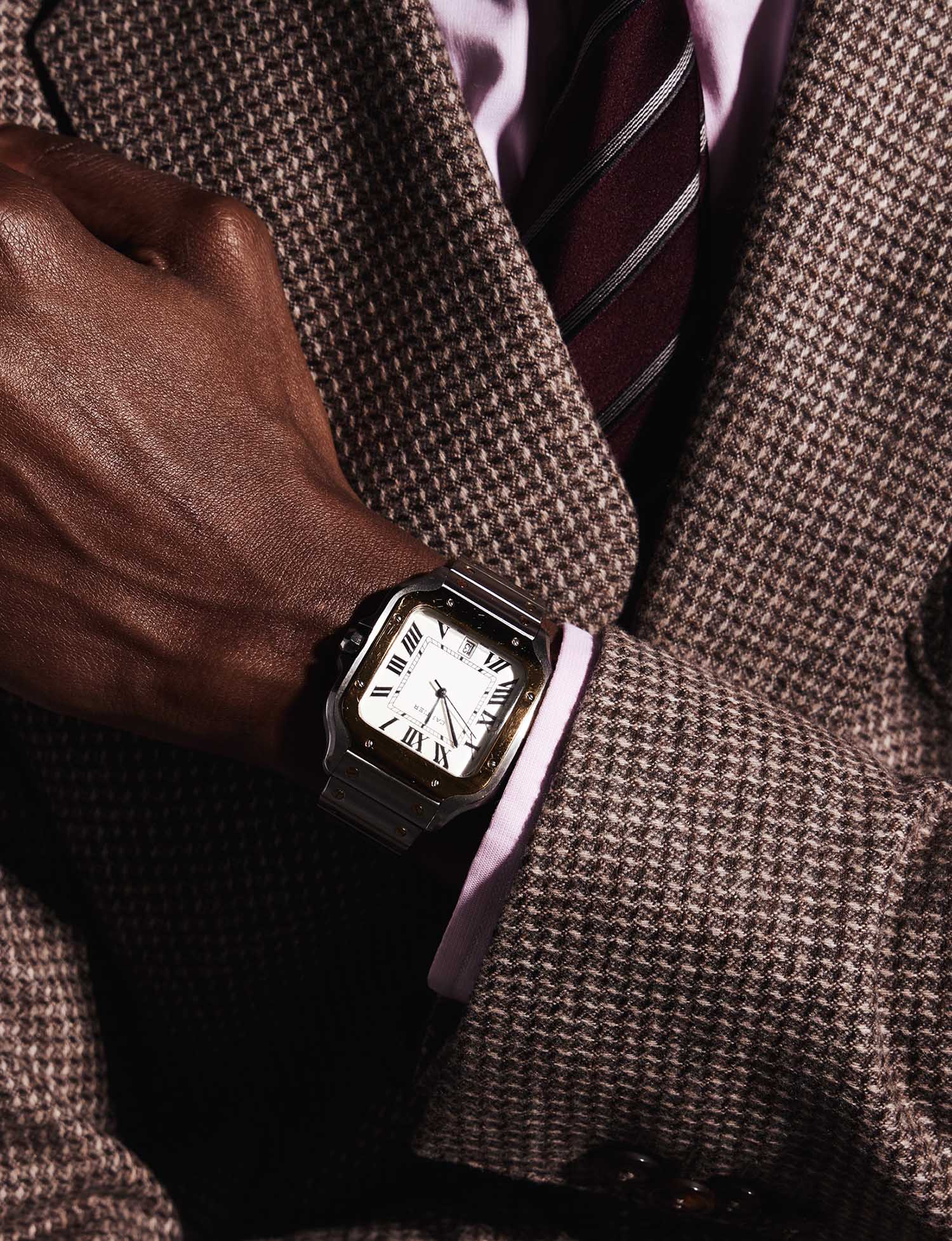
Case diameter alone rarely tells the whole story. Lug-to-lug distance, case thickness, lug shape, and the flexibility of the strap or bracelet all influence how a watch actually sits on a given wrist. A case with a perfectly reasonable diameter can still overhang noticeably if the lug-to-lug measurement runs too long for the wearer’s wrist.
A practical fit check includes:
- Measuring wrist circumference and comparing it with the watch’s total lug-to-lug length
- Checking whether the case clears a shirt or jacket sleeve comfortably
- Moving the wrist through typical motions to gauge bracelet or strap flexibility
-
Wearing the watch for several uninterrupted minutes to judge comfort before committing to a purchase
Compare Case, Crystal, and Strap Materials
Case materials such as stainless steel, titanium, ceramic, and precious metals each come with trade-offs in weight, scratch resistance, corrosion resistance, and how easily they can be refinished down the road. Heavier metals can feel substantial on the wrist but may contribute to fatigue during long wear, while titanium offers a lighter feel paired with strong corrosion resistance.
Crystal choice follows a similar set of trade-offs. Acrylic crystals resist shattering and are easy to polish, but they scratch more readily. Mineral crystals offer moderate scratch resistance at a lower cost. Sapphire crystals resist scratching exceptionally well but can be more prone to chipping on a sharp impact. Higher scratch resistance does not mean the crystal is immune to damage.
Straps and bracelets, leather, textile, rubber, or metal, affect comfort differently depending on climate, perspiration, and skin sensitivity. Because straps are replaceable, this is one component that can be adjusted later without touching the watch itself.
Read Water-Resistance Ratings Correctly
Water-resistance ratings describe performance under specified test conditions. Match the watch to your planned activities using the manufacturer’s guidance. The Federation of the Swiss Watch Industry explains that ISO 22810 sets requirements for water-resistant watches, while ISO 6425 addresses divers’ watches. A reference to either standard should reflect the specific model’s documented compliance.
Avoid operating crowns or pushers underwater unless the manufacturer expressly permits it. Follow the manufacturer’s cleaning instructions after saltwater exposure. Aging gaskets and accidental damage can reduce water resistance, so arrange checks according to the manufacturer’s recommendations and your usage.

Consider Legibility and Useful Features
Contrast between hands and dial, luminous markings, a clear date window, and an easy-to-track seconds hand all contribute to everyday usability. Crown size matters too, especially for anyone making frequent adjustments. Legibility matters more than decorative complexity for an everyday watch. Complications such as chronographs are worth having only if they serve an actual need, rather than adding functions that will go untouched.
Estimate Ownership and Maintenance Needs
The purchase price is only part of the total cost of ownership. Worth factoring in:
- Battery replacement or mechanical servicing intervals
- Strap or bracelet replacement over time
- Crystal or bezel repair costs
- Periodic water-resistance testing
- Access to qualified service providers
Service needs vary by watch and usage pattern rather than following one fixed schedule; manufacturer guidance and the watch’s actual condition should drive the timing. Holding onto purchase receipts, warranty paperwork, and service records pays off both for resale value and for making informed maintenance decisions down the line.
Use Reliable Information Before Buying
Verify specifications through official manufacturer documentation, recognized standards bodies, and qualified watchmakers rather than relying on informal claims. Be wary of vague language like “military grade,” unverifiable accuracy promises, or reviews that skip over model details. Citing recognized standards such as ISO 22810 and ISO 6425 provides a dependable basis for any water-resistance claim.
A Practical Decision Framework
- Define the primary use for the watch.
- Choose quartz or mechanical based on preferred ownership experience.
- Check case and lug dimensions against wrist size.
- Confirm case, crystal, and strap materials.
- Match water-resistance rating to actual planned activities.
- Estimate maintenance needs and service accessibility.
- Verify specifications through reliable sources.
Match specifications to your habits, not to a label or marketing claim.
Final Perspective: Choose for Fit, Function, and Long-Term Use
A satisfying watch purchase balances personal taste against measurable, practical factors: movement type, fit, materials, water resistance, legibility, and realistic maintenance expectations. Taking the time to verify specifications and picture years of actual use, rather than a single moment of admiration in a store, tends to produce choices that hold up well. The most suitable watch isn’t necessarily the most elaborate or expensive one; it’s the one that fits the wearer’s daily routine and long-term expectations.
Images from Le Noveau Homme by Yaw Asiedu – see full article here.