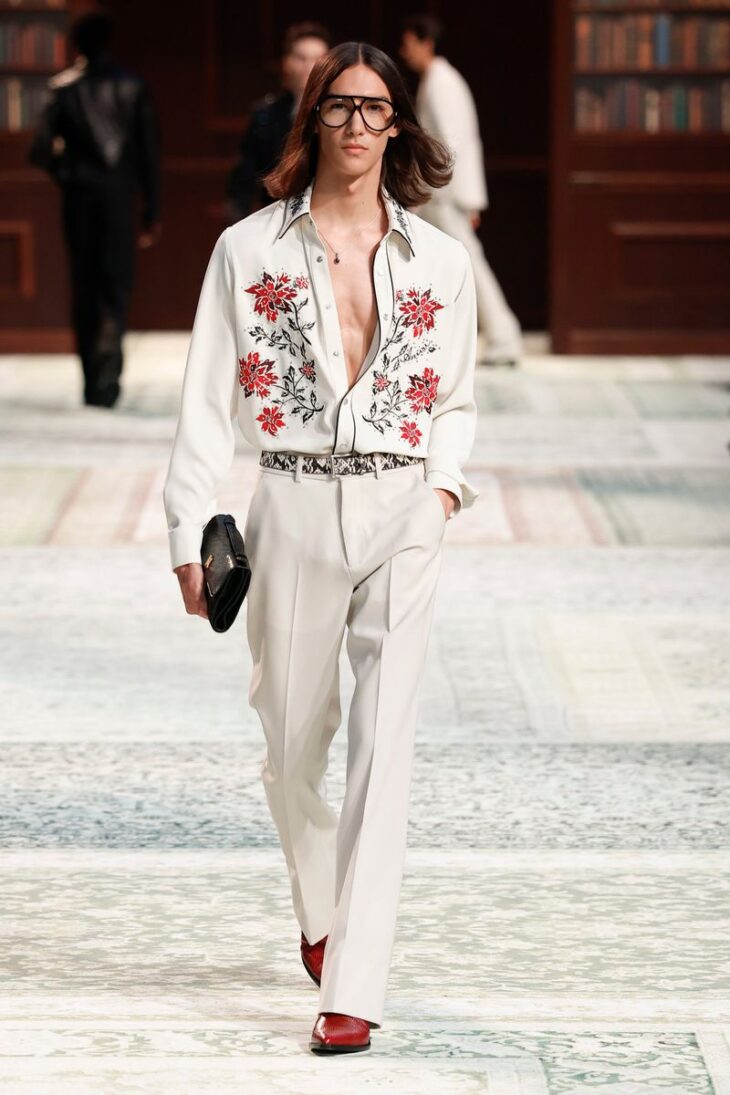
Mike Amiri channels 1970s Hollywood intimacy into a men’s collection that redefines formalwear as personal expression, cast with a diverse lineup that embodies the brand’s inclusive vision.
There’s something inherently cinematic about the way Mike Amiri approaches fashion. His collections don’t just present clothes; they construct worlds, complete with soundtracks, settings, and characters. For Fall/Winter 2026, that world is Laurel Canyon, the legendary hillside enclave above Hollywood that served as headquarters for counterculture creativity in the 1970s. The casting, assembled by Noah Shelley, reflects that era’s spirit of diversity and individuality while grounding it firmly in the present.
The Cast: Diversity as Design Philosophy
The runway featured a compelling assembly of faces that gave the collection its pulse. Ahmed Richards and Jordan Daniels brought commanding presence to the tailored pieces, while Danilo Markovic and Sava Lakic demonstrated the collection’s European appeal. The casting stretched across continents and aesthetics: Awwal Adeoti and Ottawa Kwami delivered standout moments in the more sculptural outerwear, while Chenxu He and Kaplan Hani showcased how the collection’s silhouettes translate across different frames.
LATEST FROM PARIS FASHION WEEK
Veteran faces like Baptiste Vivo and Julien Saunier anchored the lineup with seasoned confidence, their familiarity with the runway lending gravitas to the more formal pieces. Meanwhile, emerging talents including Nand Quivreux, Leo Levy, and Lucas Moullier injected youthful energy, particularly effective in the collection’s more relaxed, lived-in looks. The range, from the angular features of Nik Dermendzhiev and Viktor Krohm to the striking presence of Gaye Serigne and Vincent Dzogbenu, underscored the collection’s central thesis: these clothes are designed for individuals, not archetypes.
Particularly notable were the moments when the casting amplified the clothes’ narrative. Keanu Pauli in velvet-flocked denim, Zaram Obasi in an officer’s jacket styled with characteristic AMIRI nonchalance, Tamás Gyöngyösi demonstrating how tailoring can feel simultaneously polished and personal. The diversity wasn’t performative; it was functional, proving that the collection’s promise of universality holds true across body types, skin tones, and personal styles.
The Concept: Intimacy as Luxury
The show space abandoned traditional runway conventions in favor of something more personal. Constructed to evoke a luxurious den in an idealized Laurel Canyon home, complete with curated furniture and careworn objects, the setting invited guests inside rather than positioning them as outside observers. Models moved through the space as inhabitants rather than performers, reinforcing the collection’s central philosophy.
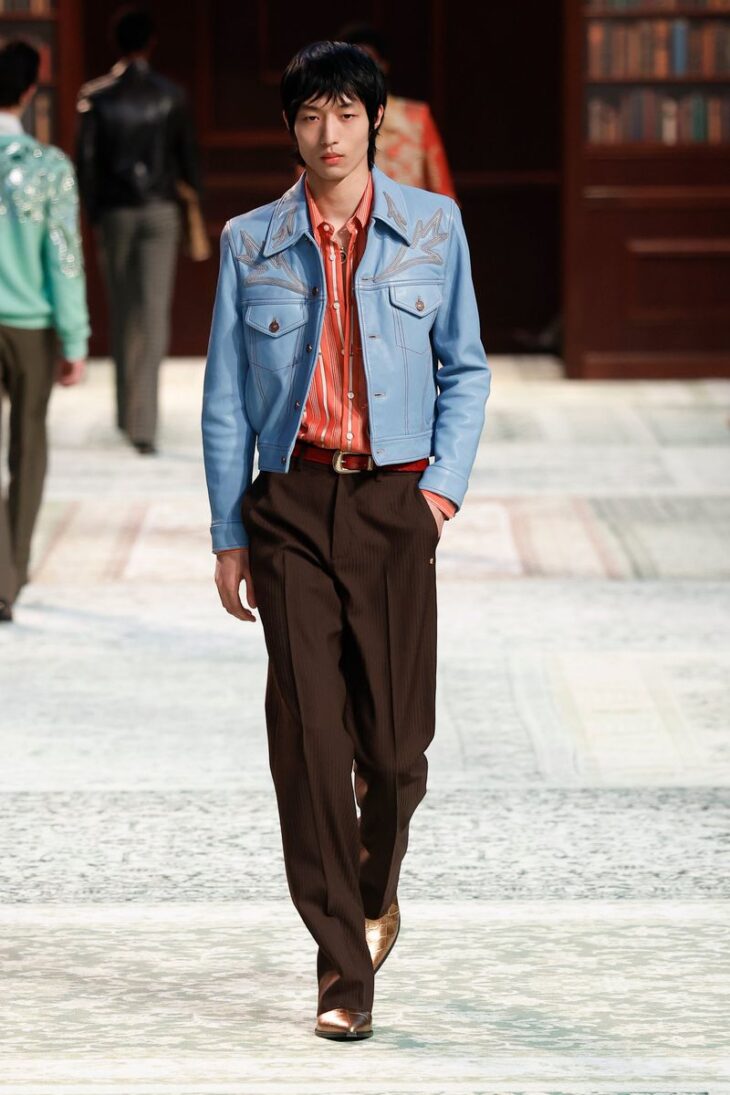
Mike Amiri articulated that philosophy in the show notes: “For me, men’s formalwear is most interesting when it feels effortless and personal. I love the idea of artists wearing tailoring in an informal way, a blazer over a Henley, boots instead of dress shoes. Clothes that feel like an extension of who you are. That balance is the sweet spot for Amiri: something that can exist on stage but also walk right off into real life.”
The 1970s Laurel Canyon reference provides more than aesthetic direction; it supplies an ethos. That decade’s West Coast style, born from musicians and artists who dressed for themselves rather than for industry expectation, translates here into a contemporary vocabulary. The collection doesn’t recreate the era; it channels its spirit of individual expression and creative freedom.
The Clothes: Formalwear Reimagined
The collection’s strength lies in its redefinition of occasion dressing. Traditional hierarchies, formal for evening, casual for day, are deliberately inverted. Tailoring appears dressed up for daytime; denim takes center stage for evening. The effect isn’t relaxation but rather a sense of occasion brought to daily life, the understanding that personal style shouldn’t be reserved for special moments.
Material work throughout rewards close inspection. Jeans flocked with rich velvet create surfaces that feel luxurious without announcing themselves. Embroideries provide punctuation and emphasis rather than overwhelming decoration. The palette carries what the brand describes as “hazed nostalgia,” deep merlot and burgundies, sage and mint green, bright blues that feel simultaneously vintage and contemporary.
The wardrobe reads as modern American classics filtered through AMIRI’s particular lens: western wear, officer’s jackets, leather, and classic denim, all given detailing expressive of the brand’s savoir-faire. Emblematic tailoring pairs with lean jeans; casual pieces mix with glamorous elements drawn from evening attire. The mood fuses easiness with elegance, on stage and off.
Signature pieces receive evolution rather than revolution. Silhouettes remain identifiable through cut; the iconic AMIRI western boots are recalibrated and updated; the eyewear proposition expands with new frames. Every seam becomes a streamlined form of decoration as well as a definition of silhouette. As Amiri puts it: “The closer you get, the more you feel.”
The Styling: Ellie Grace Cumming’s Vision
Stylist Ellie Grace Cumming’s work amplified the collection’s thesis of personal, hybrid dressing. Blazers appeared over Henleys, boots replaced dress shoes, tailored pieces mixed with relaxed knits in combinations that felt discovered rather than dictated. The styling reinforced the idea of clothes as extensions of personality, each look suggesting a specific individual rather than a generic fashion ideal.
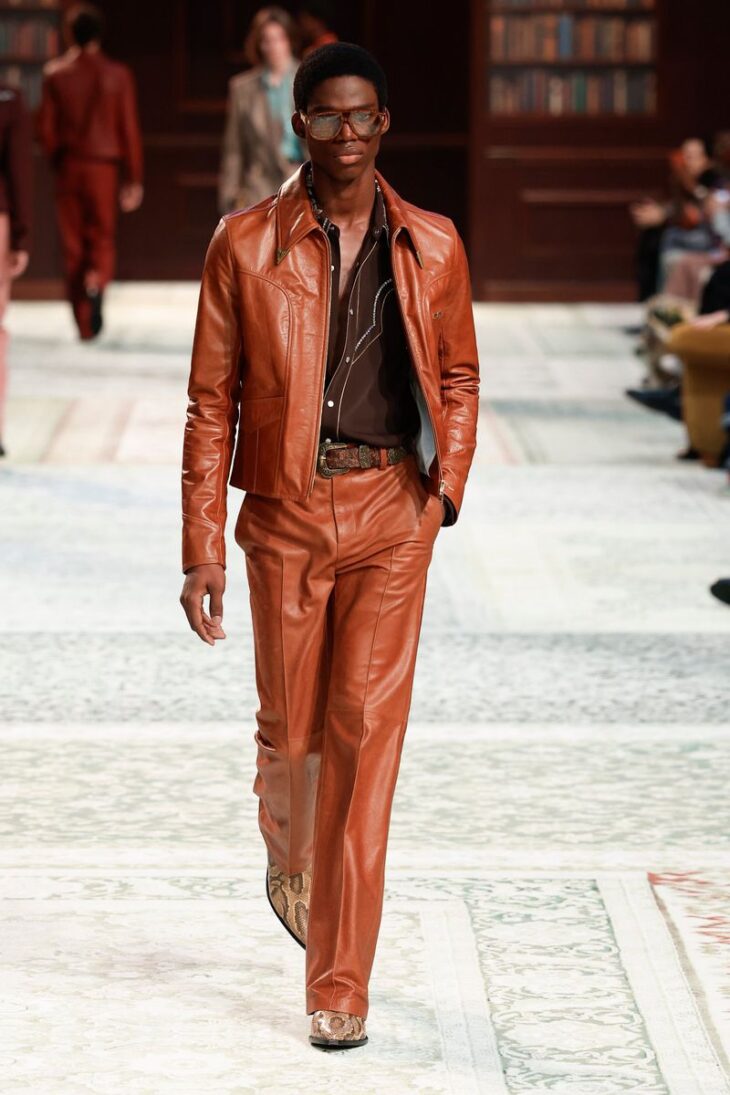
Hair by Eugene Souleiman maintained the collection’s balance between polish and ease, with styles that felt considered but not overwrought. Lucy Bridge’s makeup followed suit, enhancing rather than transforming, keeping the focus on the clothes and the men wearing them.
AMIRI Fall Winter 2026 succeeds because it understands that modern masculinity isn’t monolithic. The casting, the clothes, and the staging all reinforce a vision of menswear that accommodates individuality rather than enforcing conformity. The Laurel Canyon reference could easily have become costume, but Amiri’s genuine connection to Los Angeles, to music culture, to the idea of clothes as personal expression, keeps it grounded in reality.
The collection’s emphasis on intimacy, both in construction and presentation, signals a maturity that feels earned. These are garments designed to be lived in, loved, worn until they become extensions of personality. In an industry often obsessed with the new, AMIRI makes a compelling case for the timeless.
The closer you get, the more you feel. It’s a fitting philosophy for a collection that rewards attention.
Discover more of the collection in our gallery:
Credits
- Designer: Mike Amiri
- Fashion Editor/Stylist: Ellie Grace Cumming
- Hair Stylist: Eugene Souleiman
- Makeup Artist: Lucy Bridge
- Casting Director: Noah Shelley
- Models: Ahmed Richards, Alexander Kosi, Alexandre Vidal, Alvise Candida, Angel Galego, Ashley Lauren, Awwal Adeoti, Ayman Salah, Baptiste Vivo, Benedikt W, Chenxu He, Danilo Markovic, Dara Gueye, Edoardo Duse, Gaye Serigne, Jessie Aina, Jordan Daniels, Julian Silvester, Julien Saunier, Kai Wijers, Kaplan Hani, Keanu Pauli, Lebo Malope, Leo Levy, Lucas Moullier, Muzakir Masahudu, Nana Yaw Akuamoah, Nand Quivreux, Nataniel Busa, Nik Dermendzhiev, Oleksandr Kaminskyi, Ottawa Kwami, Pierrick Grégoire, Rubuen Bilan-Carroll, Samuel Elie, Saul Symon, Sava Lakic, Silouane V, Tamás Gyöngyösi, Trystan Ricketts, Viktor Krohm, Vincent Dzogbenu, William Puatany, Zaram Obasi
Full Amiri Fall Winter 2026 runway collection with women’s looks is now live on DSCENE Magazine.