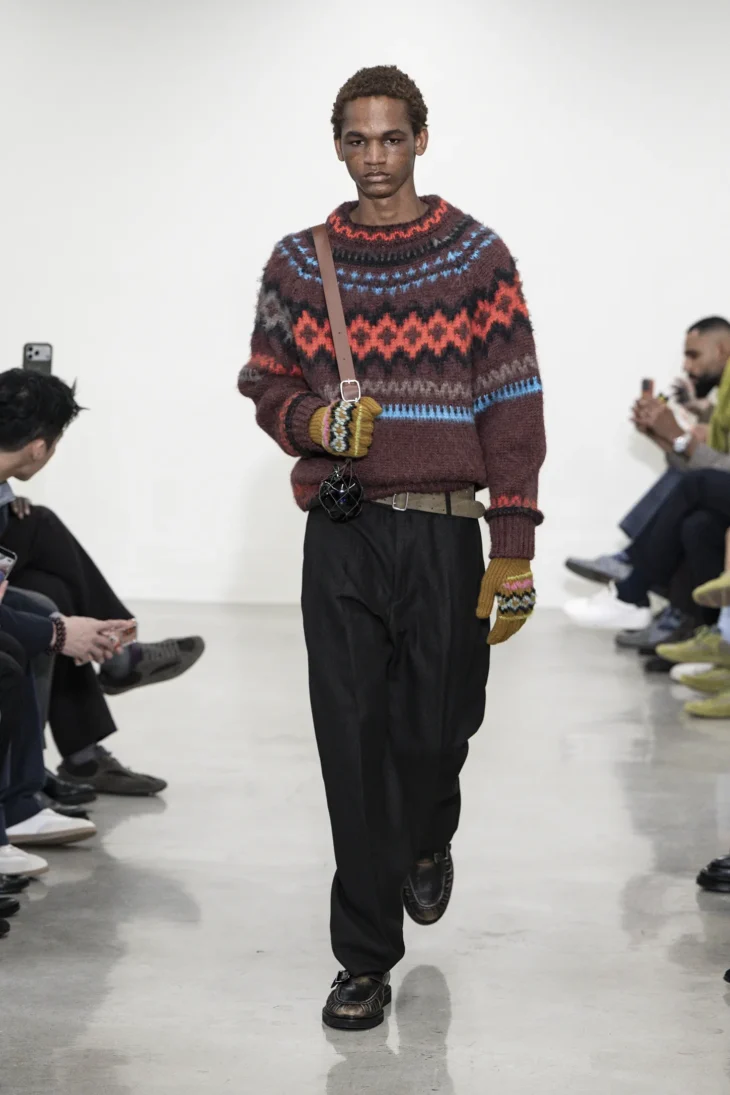
Paul Smith‘s decision to relocate from Paris to Milan for Fall Winter 2026 carries symbolic weight that extends beyond logistics. Planting his flag in the global capital of men’s tailoring, the designer delivered a collection that functions as both retrospective and reinvention, a meditation on five decades of craftsmanship filtered through contemporary sensibilities.
The intimate salon-style presentation at Paul Smith’s Milan headquarters stripped away the spectacle that dominates fashion week calendars. What remained was clothing, pure and considered, worn by a cast that embodied the collection’s central tension between heritage and evolution.
The Archive as Living Document
Central to this collection is the collaboration between Smith and Sam Cotton, his longtime mentee now serving as Head of Men’s Design. Together, they excavated the brand’s Nottingham archive, a repository of nearly 5,000 garments spanning 55 years, approaching it not as sacred ground but as raw material for reinterpretation.
MORE MILAN FASHION WEEK
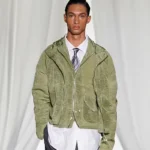
The silhouettes that emerge carry DNA from Paul Smith’s most influential periods, particularly the late 1980s and early 1990s when the brand helped redefine British tailoring for a generation resistant to stuffiness. Jackets arrive with their construction deliberately revealed, linings exposed, seams turned outward. It’s deconstruction in service of transparency, showing the work that goes into making clothes this considered.
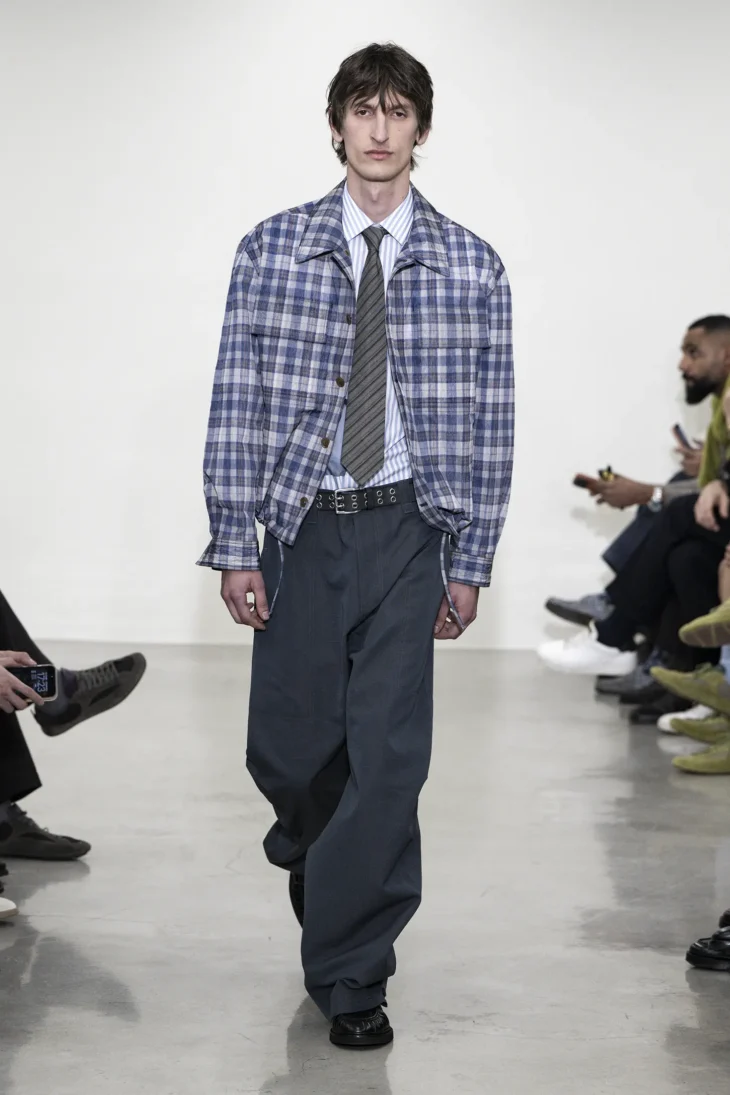
Harris Tweed and Donegal fabrics ground the collection in British textile tradition, their weight and texture providing counterpoint to moments of unexpected lightness. Sheer fabrics appear throughout, playing with visibility and shadow in ways that feel genuinely modern rather than merely provocative.
Cocteau’s Shadow
Jean Cocteau emerges as the collection’s spiritual guide, the French polymath who spent his life in a personal uniform of shirt and tie, proving that consistency and creativity need not conflict. For Smith, who has worn a suit daily for decades, the connection runs deeper than aesthetic appreciation.
The Cocteau influence manifests in layered details: cuffs that stack with intention, button covers that recall an earlier era of masculine dressing, fabrics that reveal as much as they conceal. There’s a lived-in quality throughout, as if these clothes arrived with histories already attached.
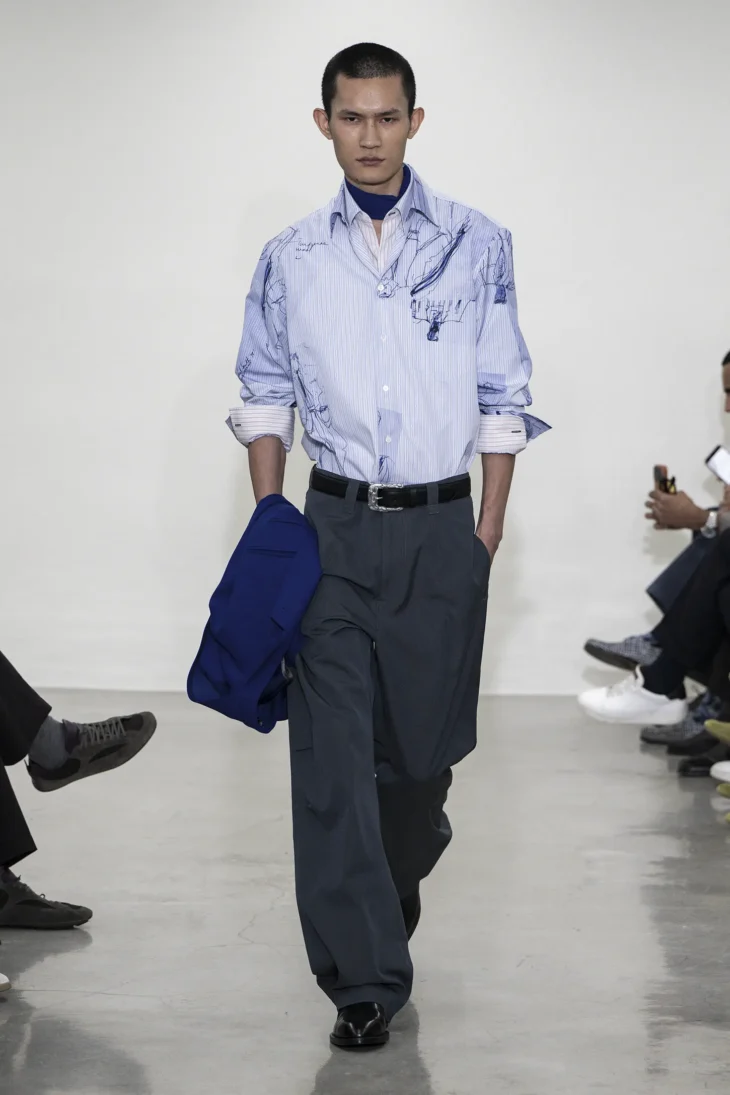
Color operates strategically. Deep autumnal foundations, rich burgundies, forest tones, warm browns, create space for the punctuation marks of print and pattern that have always defined Paul Smith’s visual language. Polka dots return, rendered in treatments that explore transparency. Hand-drawn pears inject playfulness without undermining the collection’s serious tailoring credentials. Prints sourced from Paul Smith’s father’s photography archive appear on shirting, adding personal narrative to commercial product.
The Magpie Principle
Smith describes the collection through the lens of “magpie dressing”, the accumulation of treasures, the gathering of disparate elements into cohesive personal style. It’s an apt framework for understanding how the collection functions on the runway: nothing matches in the conventional sense, yet everything belongs together.
Accessories reinforce this philosophy. Leather goods arrive deliberately tumbled and distressed, suggesting objects with provenance rather than pristine newness. Bags, belts, and charms look collected rather than purchased, continuing the meditation on accumulation that runs through every aspect of the presentation.
Setting and Sound
The Milan headquarters transformed for the occasion, with a mural by Colin Barnes—who captured some of the earliest Paul Smith designs in 1976, establishing immediate connection to the brand’s origins. Trompe L’oeil techniques created moments of visual surprise throughout the space, while wooden benches wore prints depicting everyday objects: scissors, coffee cups, the ordinary items that have always fueled Smith’s creative imagination.
Music by Andrew Hale and Peter Smith provided atmospheric accompaniment, while Holmes Production handled staging that prioritized intimacy over impact.
The Cast
The collection found its fullest expression on a diverse cast that brought individual character to each look:
Adeshina David | Ahmed Richards | Alvar af Schultén | Amedeo Mancini | Awwal Adeoti | Bai | Baptiste Vivo | Chubath Kutien | Colin Otto | Dario Tonin | Edoardo Duse | Fares Ben M’barka | Fernando Cabral | Gideon Adeniyi | Haoran Xu | Hedi Ben Tekaya | Ivan Zahorniy | Joshua Thompson | Kaplan Hani | Laurenz Houston | Mack Karpes | Noah Herbst | Samuel Elie | Theodor Pal | Thibaud Charon | Vasko Luyckx | Yuto Ebihara
Casting by Ben Grimes assembled a lineup that reflected the collection’s global perspective while maintaining the individual character that salon-style presentations demand. Hair and makeup by Matt Mulhall kept grooming natural, allowing the clothes to command attention.
The Larger Conversation
Paul Smith’s Milan arrival poses questions the industry seems reluctant to address. In a landscape where tailoring often feels like afterthought or costume, here is a designer who has spent five decades proving that the suit remains menswear’s most versatile canvas.
The Fall Winter 2026 collection doesn’t argue for tradition over innovation. Instead, it demonstrates that the two have never been mutually exclusive—that understanding construction deeply enough to subvert it produces more interesting results than abandoning it entirely.
For a generation of men uncertain about what dressing well actually means, Paul Smith offers an answer that feels neither prescriptive nor nostalgic. These are clothes for people who want to look considered without looking costumey, who understand that personal style emerges from accumulation rather than adherence.
Milan has a new resident. The conversation about tailoring just got more interesting.
Discover the full Paul Smith Fall Winter 2026 collection in our gallery:
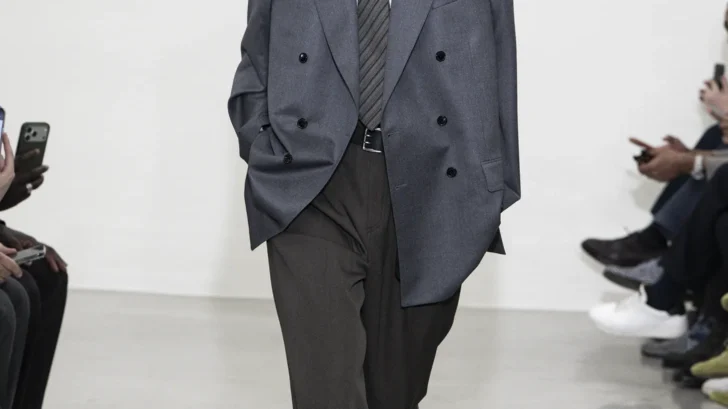
Styling by Ben Schofield | Casting by Ben Grimes | Hair & Make-up by Matt Mulhall | Production by Holmes Production | Music by Andrew Hale and Peter Smith