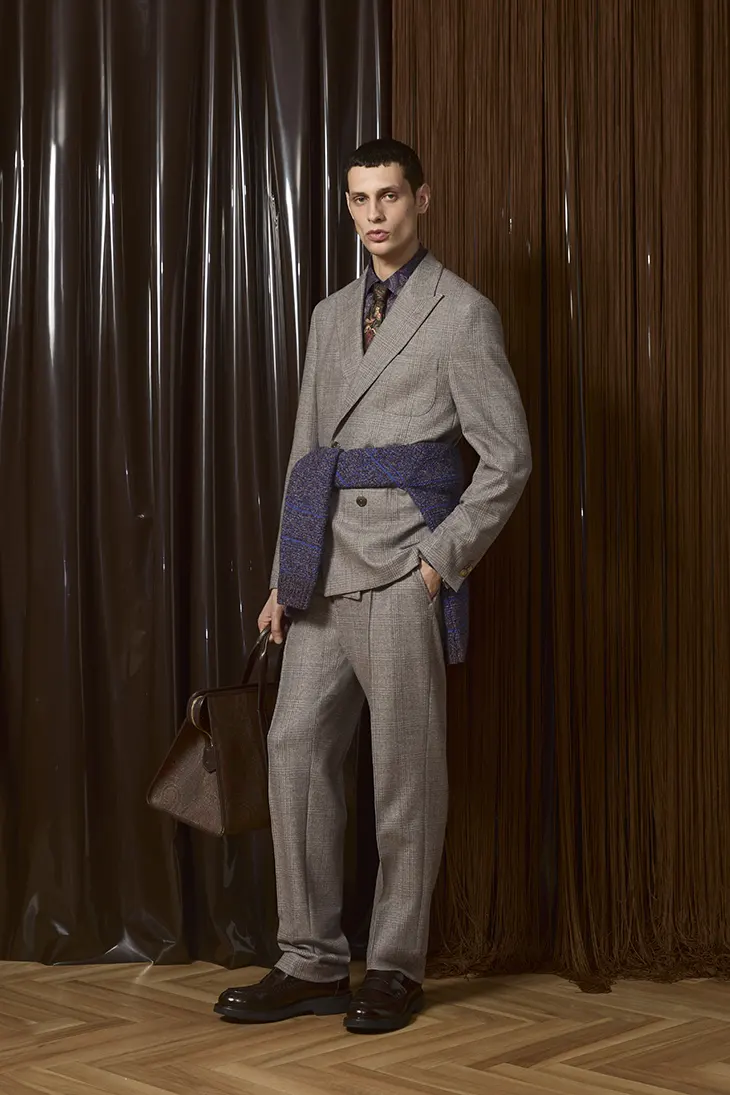
Marco De Vincenzo’s ETRO menswear presentation transforms two rising faces into hybrid creatures caught between instinct and refinement.
For his Fall Winter 2026 menswear presentation, Marco De Vincenzo eschewed the traditional runway format in favor of something more intimate and unsettling. Inside the dim back rooms of a Brera trattoria, mannequins stood frozen alongside live models, their human features obscured by Venetian papier-mâché masks depicting foxes, owls, rams, and bears. Among those bringing the collection to life were Fares Ben M’barka and Tommaso Zana, two faces whose distinct presences anchored the designer’s exploration of masculinity as both camouflage and plumage.
The Faces Behind the Masks
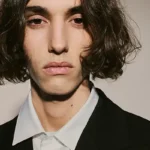
Paris-based Fares Ben M’barka, represented by Success Models in Paris, Soul Artist Management in New York, d’management group in Milan, Supa Model Management in London, and Sight Management Studio in Barcelona, brought a contemplative intensity to the presentation. His angular features and dark curls provided the perfect canvas for De Vincenzo’s vision of the civilized animal, a man whose refined exterior barely contains something wilder beneath.
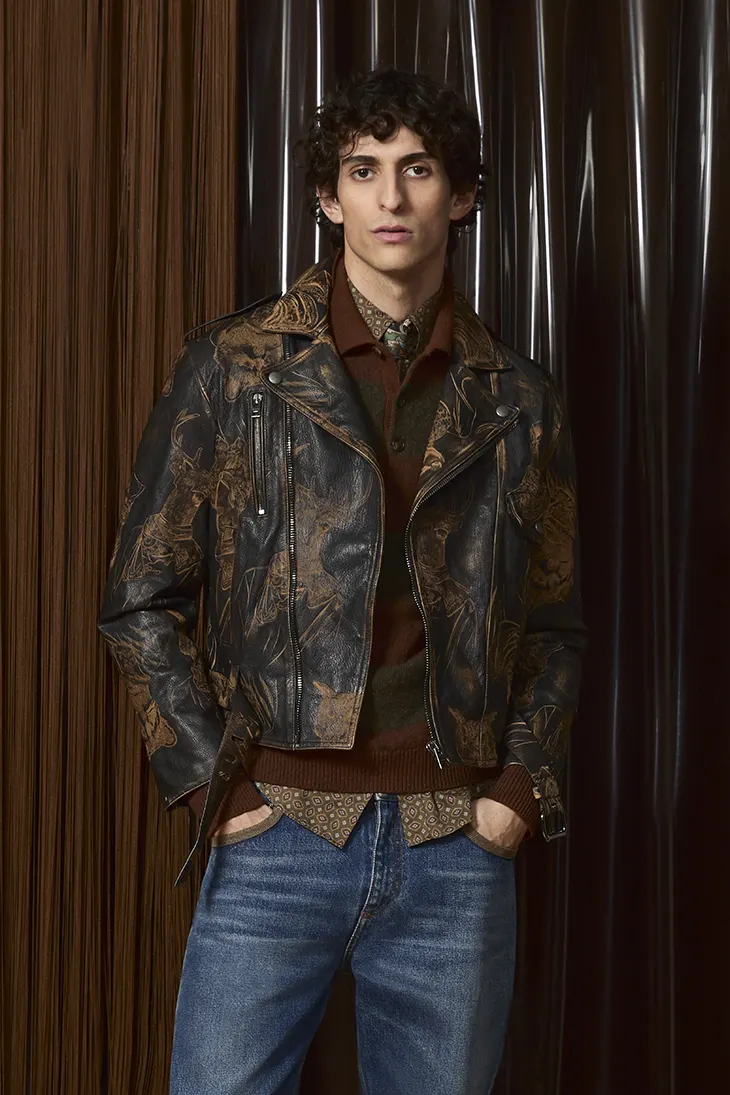
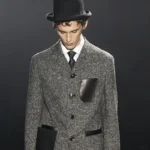
Milan-based Tommaso Zana, scouted by CS scouting and now represented by Why Not Model Management in Milan, The Claw in Paris, VNY Models in New York, Supa Model Management in London, Uno Models in Barcelona, and nest model management in Berlin, offered a contrasting energy. His presence communicated the collection’s tension between bourgeois propriety and feral instinct, embodying the Animen concept with a quiet confidence that suited the static presentation format.
The Collection Context
The presentation’s title, “Animen: Rebooted,” references a 1997 photographic campaign conceived by Kean Etro that explored physiognomy and the notion that human traits often mirror animal ones. De Vincenzo found this tension between the civilized and the feral to be fertile ground for exploration, consulting with Kean Etro to understand the deeper meaning behind the archival iconography before translating it into contemporary menswear.
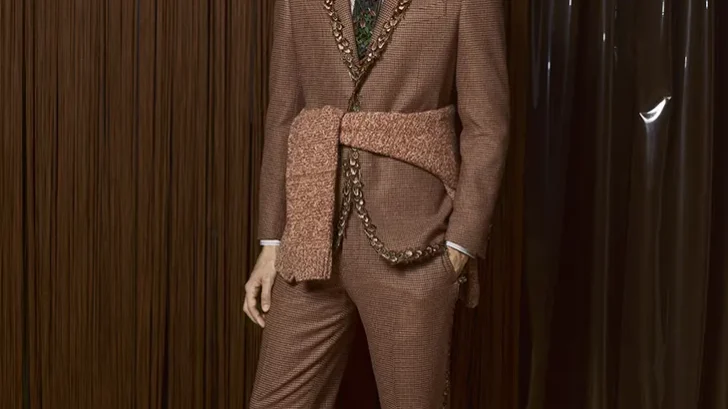
The garments themselves straddled the line between weekend-in-the-country propriety and wild eccentricity. The palette ran to dense browns, velvety greens, and sensuous garnet reds, shades that suggest camouflage rather than display. Robust tweeds in tawny brown and rust featured lapels adorned with feathers, while slim-lapel tailoring trimmed with plumage transformed the traditional suit into something approaching heraldry.
Material Language
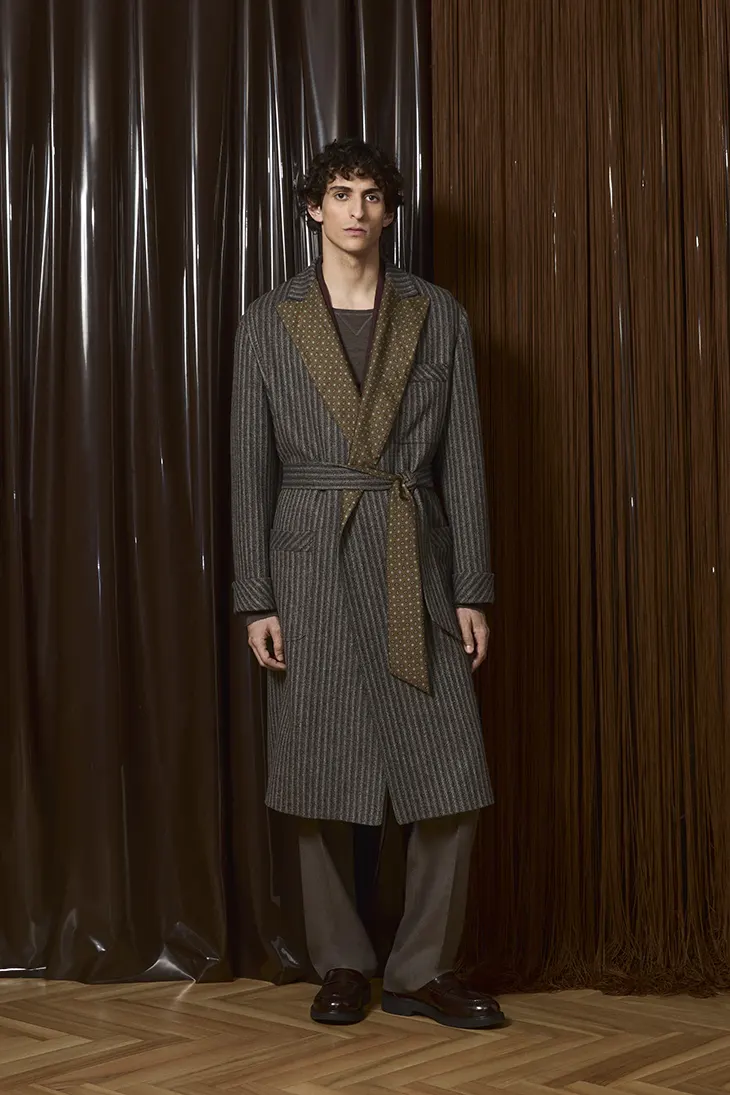
De Vincenzo applied pixelated jacquards to plush knitwear, with deer faces peeking out from chest panels. Leather biker jackets and evening blousons bore owl faces worked directly into the material. Paisley, the house’s genetic marker, covered silky shirts and fancy dinner jackets, spreading across trousers, scarves, and robe-coats with the confidence of a family crest.
The designer paired these intricate textiles with velvet robes and slouchy pajamas, suggesting a lifestyle that values comfort as much as display. Sweaters tied at the waist, soft roomy bags, and caps pulled down over heads sealed this casual attitude. The Animen appeared relaxed in their finery, resembling aristocrats who had embraced their true nature.
Presentation Design
The presentation unfolded to the hypnotic hum of Wendy Carlos, the Moog synthesizer pioneer famous for her soundtracks to films like A Clockwork Orange. De Vincenzo sees a parallel between her work and his own approach to the house: taking classical compositions and rewiring them for a new era. The intimate trattoria setting, with its faintly wunderkammer atmosphere, allowed viewers to study both the clothes and the models who wore them with an attention that traditional runway pacing would have denied.
The ETRO Man Defined
After more than three years of directing the brand, De Vincenzo has described his approach as “maximalist minimalism,” a phrase that captures the collection’s essential tension. The clothes are dense with detail and reference, yet they maintain a certain restraint in silhouette and proportion. This season’s ETRO man, as embodied by Ben M’barka and Zana, is not one to follow the herd. He wears his mask not to conceal but to reveal something essential about his nature.
The collection succeeds in positioning ETRO menswear as something more than heritage-driven Italian luxury. In a fashion landscape increasingly dominated by safe bets, the house’s willingness to embrace the strange remains both refreshing and commercially astute.
ETRO Fall Winter 2026 Menswear was presented during Milan Fashion Week in January 2026. Discover more in our gallery:
Images courtesy of ETRO